
NATA-NY is an organizational matrix in which individuals and communities can activate to manifest their intrinsic autonomy. We are a decentralized and leaderless network that aspires to increase the empowerment and independence of all people living in the New York area.
Showing posts with label Anarchy / Autonomy. Show all posts
Showing posts with label Anarchy / Autonomy. Show all posts
Tuesday, May 24, 2016

Friday, October 23, 2015
Taking the ATS Philosophy and Strategy to the Next Level: Building the Pan-Secessionist Meta-Party
By Keith Preston
In the essay, “Liberty and Populism: Building an Effective Resistance Movement for North America,” written in 2006, I made the following observation:

Since the above was written, at least two proposals have been put forward concerning how the type of meta-party described above might be organized and what it’s orientation might be. The most elaborate plan of this kind has been advanced by Ryan Faulk’s All Nations Party. The ANP is a proposed pan-secessionist party that would have ethnic separatism as its primary, though not necessarily exclusive, orientation. Another such proposal is Joe Kopsick’s Pananarchist Party USA, which seeks to advance the concept of non-territorial governments within a general individualist anarchist framework. While both proposals are a commendable efforts to open dialogue and engage in strategic formulation on this question, in both instances there might also be a bit of overreach.
Twenty-five percent of the US population currently expresses at least casual sympathy for the idea of a secessionist movement in their own region or locality. The principle objective for those of us who have embraced the pan-secessionist strategy should at this point be the awakening of this sleeping giant. The question is how to we turn this mass of 80 million passive sympathizers into a mass of active sympathizers? The first thing that should be recognized is that most of these 80 million potential constituents are not adherents of extremist or exotic ideologies. Instead, the bulk of the opinions held by these people are likely to be rather close to the mainstream on most issues.
There is no evidence that there is a sizable constituency for ethnic separatism within any ethnic group. To be sure, there is a tiny but outspoken minority of people within all ethnic groups who advocate for ethnic separatism, but the sum total of all ethnic separatists within all ethnic groups would still be a tiny fraction of the 320 million people who make up the US population. It is also true that there are many people who practice de facto ethnic separatism, but this largely reflects the economic and lifestyle choices of individuals, and is a far cry from advocating de jour ethnic separatism as a matter of ideology or moral conviction. While it is certainly true that ethnic separatists can also be pan-secessionists, it is unlikely that a pan-secessionist meta-party (PSMP) that advances ethnic separatism as a primary value will win a great deal of sympathy.
Likewise, it is unlikely that a PSMP that is primarily oriented towards the promotion of an esoteric or exotic ideology will gain much of an audience. While there are certainly plenty of historical precedents for such concepts as non-territorial governments, such ideas are also culturally alien to the overwhelming majority of persons in North America. Therefore, it would be unwise to adopt an ideological stance of this kind as principal strategic objective.
However, the concept of secession maintains very powerful roots within mainstream American history, culture, and politics for reasons that are too obvious to require discussion. Further, secession is a tactical concept that can be embraced by movements of any ideological, cultural, ethnic, religious, or economic orientation. How then should a PSMP organize itself?
The All Nations Party idea of a PSMP that functions as a umbrella for a set of constituent parties and regional or local secessionist movements that have their own interests is generally a solid one. However, I would suggest that at the meta-party level the PSMP should have only two stated objectives:
1. Promoting, advocating, legitimizing, and legalizing the right of secession by regions and localities from larger governmental units.
2. Promoting, advocating, legitimizing, and legalizing the right of minor parties to participate in public elections against the present two-party duopoly.
From this basic starting point, the constituent parties and secessionist movements associated with the PSMP would have every right to advocate for whatever philosophies or issues they wished. For example, the PSMP would have no position on foreign policy. If a collection of red state secessionists wished for the red states to go to war with ISIS, then so be it. The PSMP would have no position on economics. Presumably, for example, there would be both advocates of socialism and capitalism within the PSMP. The PSMP would exist only for the purpose of defending the rights of constituent groups to form their own parties or secessionist movements advocating for any ideas that they wished, and to strip away political and legal barriers to both competition in public elections by minor parties and secession by regionalist movements. This is does not in any way mean that any constituent party, organization, or movement of the PSMP would abandon or even downplay any of its other issues. It simply means that the PSMP would provide an organizational umbrella for the advancement of the interests of all minor parties and secessionist movements at the collective level. Within the framework of the PSMP, socialists would still advocate for single-payer healthcare, libertarians for tax cuts, social conservatives for the pro-life cause, and social leftists for LGBT issues. The PSMP would no doubt include many constituencies who were otherwise antithetical to each other, such as the Prohibition Party and the U.S. Marijuana Party.
In this sense, it must be understood that the PSMP would maintain both macro-level constituencies and micro-level constituencies. At the macro-level, the PSMP would have only two constituencies: the 25% and growing number of Americans who sympathize with the idea of secession, and those who prefer alternatives to the two-party duopoly. At the macro-level, the PSMP would exist only to promote the two issues of third party rights and secessionist rights, and these issues would be promoted in the same way that proponents of marijuana legalization, gay marriage, gun rights, gun control, the right-to-life or abortion rights have promoted their own issues. At the micro-level, the PSMP would have many constituencies, i.e. the constituencies of its component parties, organizations, movements, and the issues raised by each of these. Obviously, the opportunity would arise within such a scenario for a infinite variety of conflicts between the various constituents of the PSMP, and such conflicts are to be expected. Therefore, mutual agreements among the PSMP constituents would have to be formulated in order to maintain the common peace to the greatest degree reasonably possible. The most practical approach would be for the various constituent forces to simply agree to stay out of each other’s backyards. For example, the constituents forces that trended rightward would agree to focus their organizing and recruiting activities on the “red” demographic sectors of the US, and the forces that trended leftward would agree orient themselves towards organizing among the “blue” sectors.
At the national level, the presidential candidates of the PSMP would run solely on the two core principles of the PSMP: advocating for the rights of third parties, and the rights of secessionists. Preferably, the presidential ticket would be split between the Left and Right. For example, the presidential candidate might be from the Socialist Party or the Green Party, while the vice-presidential candidate would be from the Libertarian or Constitution Parties. Further, the Left/Right split ticket should be reversed every four years. For example, in the 2016 election the presidential candidate might be from the Left with the vice-presidential candidate might be from the Right. In 2020, the presidential candidate would then be from the Right while the vice-presidential candidate would be from the Left.
All other candidates of the PSMP would run on joint tickets of both the PSMP and their respective constituent parties. For example, the candidate for the governorship of Massachusetts might run on the tickets both the PSMP and the Socialist Action Party, and a comparable candidate in Texas might run on the tickets of both the PSMP and the Objectivist Party. Once again, in order to avoid overlap, rival constituent parties and organizations would mutually agree to stay out of each others backyards. Additionally, the candidates from minor parties and secessionist movements might also be combined at times. For example, a candidate in Georgia might stand simultaneously for the PSMP, Constitution Party and the League of the South, while a candidate in Oregon might stand for the PSMP, Green Party and Cascadia.

An approach of the kind that has been outlined above would serve multiple purposes. One would be to simply awaken the sleeping giant of potential secessionist sympathies among one-quarter of the U.S. population, and to challenge the Democratic-Republican two-party duopoly. Yet another would be to create a forum where many different kinds of people with otherwise opposed philosophies would be able to work with one another against the common enemy. A third would be to create a prototype for the kind of system that might exist following the inevitable demise of the present system, a decentralized system based on the principal of self-determination for all.
Of course, the emergence of a PSMP of the kind described above would also receive a great deal of criticism from a variety of sources. The critics would include ideologues and sectarians of both the left and right, the professional anti-rightist cottage industry, anti-leftists of a comparable nature, avowed statists and totalitarians, neoconservatives, jingoists, the party hacks of the system’s parties, their kept media, and, of course, the overlords of the system themselves. So be it. Revolutionaries without enemies are not revolutionaries at all.
Of course, some from the general anarchist milieus will object that party politics is antithetical to the wider anarchist values of rejection of the state. I previously address this question in “Liberty and Populism,”:
The general demographic and electoral base of the PSMP would be that which has previously been outlined in “Liberty and Populism,” though periodically modified in order to adapt to changing trends. The PSMP would then emerge as a populist alternative political force perhaps comparable to Italy’s Five Star Movement, or the recently formed coalition in Greece between Syriza and the Independent Greeks. There is also the further possibility of the PSMP embedding itself in the major parties on the ground level. For example, Norman Mailer’s secessionist “left-conservative” Democratic candidacy for mayor of New York in 1969 is one example, and Larry Kilgore’s secessionist conservative Christian Republican candidacy for Senator from Texas in 2008 is another example.
The PSMP and the Pan-Anarchist Movement
Within the context of the PSMP, the pan-anarchist movement would then work to advance its wider body of strategic and political ideas such as core demographic theory, fourth generation warfare, libertarian populism, inside/outside strategy, left/right/center tripartite strategy, alternative infrastructure, cultural organizations that would replace the state’s social infrastructure, the 25 point platform, building coalitions of anti-state interest groups, a peoples’ economic front, legal defense organizations, civilian defense organizations,expanded cop watch and neighborhood watch programs, tax protests, civil disobedience campaigns, Kevin Carson’s “political program for anarchists,” Larry Gambone’s “populist groundswell” and decentralist economics, a coalition against consensual crimes, a prisoner amnesty movement, a libertarian common law system, a Norwegian approach to criminology, a Swedish or Swiss approach to foreign policy, the city-state system, and much else.

Once again, none of this meta-political or meta-strategic program implies that any of the myriad of anarchist, libertarian, anti-statist, anti-authoritarian, or decentralist factions would abandon their preferred issues. As I wrote in “Philosophical Anarchism and the Death of Empire” concerning the concept of “anarcho-populism”:

The main thing that is needed as this point is action. It is necessary for activists to step forward and being applying the ideas that have been outined above. How did other movements that have achieved a great deal of success, or at least size and recognition, begin? How did the marijuana legalization movement being? The gay marriage movement? The Tea Parties? The anti-Vietnam War movement? The civil rights movement? The religious right? The modern American conservative movement? Surely, there are things that can be learned from each of these.
In the essay, “Liberty and Populism: Building an Effective Resistance Movement for North America,” written in 2006, I made the following observation:
Ultimately, we may at some point be able to combine the Green, Libertarian, Populist, Constitution, Natural Law and other minor parties into a single party,… I would suggest calling such a party the “Federalist Party” for several reasons. First, there is precedent for this from American history. Second, it accurately describes what the internal structure of the party should be. Third, it provides a model for the general types of institutional arrangements we should seek to develop. Perhaps our party flag could be an anarchist black flag with the snake from the “don’t tread on me” Gadsen battle flag embroidered on it.It is now time to begin the application of the core strategic ideas outlined in such ARV-ATS documents and “Liberty and Populism” and “Philosophical Anarchism and the Death of Empire.”
Since the above was written, at least two proposals have been put forward concerning how the type of meta-party described above might be organized and what it’s orientation might be. The most elaborate plan of this kind has been advanced by Ryan Faulk’s All Nations Party. The ANP is a proposed pan-secessionist party that would have ethnic separatism as its primary, though not necessarily exclusive, orientation. Another such proposal is Joe Kopsick’s Pananarchist Party USA, which seeks to advance the concept of non-territorial governments within a general individualist anarchist framework. While both proposals are a commendable efforts to open dialogue and engage in strategic formulation on this question, in both instances there might also be a bit of overreach.
Twenty-five percent of the US population currently expresses at least casual sympathy for the idea of a secessionist movement in their own region or locality. The principle objective for those of us who have embraced the pan-secessionist strategy should at this point be the awakening of this sleeping giant. The question is how to we turn this mass of 80 million passive sympathizers into a mass of active sympathizers? The first thing that should be recognized is that most of these 80 million potential constituents are not adherents of extremist or exotic ideologies. Instead, the bulk of the opinions held by these people are likely to be rather close to the mainstream on most issues.
There is no evidence that there is a sizable constituency for ethnic separatism within any ethnic group. To be sure, there is a tiny but outspoken minority of people within all ethnic groups who advocate for ethnic separatism, but the sum total of all ethnic separatists within all ethnic groups would still be a tiny fraction of the 320 million people who make up the US population. It is also true that there are many people who practice de facto ethnic separatism, but this largely reflects the economic and lifestyle choices of individuals, and is a far cry from advocating de jour ethnic separatism as a matter of ideology or moral conviction. While it is certainly true that ethnic separatists can also be pan-secessionists, it is unlikely that a pan-secessionist meta-party (PSMP) that advances ethnic separatism as a primary value will win a great deal of sympathy.
Likewise, it is unlikely that a PSMP that is primarily oriented towards the promotion of an esoteric or exotic ideology will gain much of an audience. While there are certainly plenty of historical precedents for such concepts as non-territorial governments, such ideas are also culturally alien to the overwhelming majority of persons in North America. Therefore, it would be unwise to adopt an ideological stance of this kind as principal strategic objective.
However, the concept of secession maintains very powerful roots within mainstream American history, culture, and politics for reasons that are too obvious to require discussion. Further, secession is a tactical concept that can be embraced by movements of any ideological, cultural, ethnic, religious, or economic orientation. How then should a PSMP organize itself?
The All Nations Party idea of a PSMP that functions as a umbrella for a set of constituent parties and regional or local secessionist movements that have their own interests is generally a solid one. However, I would suggest that at the meta-party level the PSMP should have only two stated objectives:
1. Promoting, advocating, legitimizing, and legalizing the right of secession by regions and localities from larger governmental units.
2. Promoting, advocating, legitimizing, and legalizing the right of minor parties to participate in public elections against the present two-party duopoly.
From this basic starting point, the constituent parties and secessionist movements associated with the PSMP would have every right to advocate for whatever philosophies or issues they wished. For example, the PSMP would have no position on foreign policy. If a collection of red state secessionists wished for the red states to go to war with ISIS, then so be it. The PSMP would have no position on economics. Presumably, for example, there would be both advocates of socialism and capitalism within the PSMP. The PSMP would exist only for the purpose of defending the rights of constituent groups to form their own parties or secessionist movements advocating for any ideas that they wished, and to strip away political and legal barriers to both competition in public elections by minor parties and secession by regionalist movements. This is does not in any way mean that any constituent party, organization, or movement of the PSMP would abandon or even downplay any of its other issues. It simply means that the PSMP would provide an organizational umbrella for the advancement of the interests of all minor parties and secessionist movements at the collective level. Within the framework of the PSMP, socialists would still advocate for single-payer healthcare, libertarians for tax cuts, social conservatives for the pro-life cause, and social leftists for LGBT issues. The PSMP would no doubt include many constituencies who were otherwise antithetical to each other, such as the Prohibition Party and the U.S. Marijuana Party.
In this sense, it must be understood that the PSMP would maintain both macro-level constituencies and micro-level constituencies. At the macro-level, the PSMP would have only two constituencies: the 25% and growing number of Americans who sympathize with the idea of secession, and those who prefer alternatives to the two-party duopoly. At the macro-level, the PSMP would exist only to promote the two issues of third party rights and secessionist rights, and these issues would be promoted in the same way that proponents of marijuana legalization, gay marriage, gun rights, gun control, the right-to-life or abortion rights have promoted their own issues. At the micro-level, the PSMP would have many constituencies, i.e. the constituencies of its component parties, organizations, movements, and the issues raised by each of these. Obviously, the opportunity would arise within such a scenario for a infinite variety of conflicts between the various constituents of the PSMP, and such conflicts are to be expected. Therefore, mutual agreements among the PSMP constituents would have to be formulated in order to maintain the common peace to the greatest degree reasonably possible. The most practical approach would be for the various constituent forces to simply agree to stay out of each other’s backyards. For example, the constituents forces that trended rightward would agree to focus their organizing and recruiting activities on the “red” demographic sectors of the US, and the forces that trended leftward would agree orient themselves towards organizing among the “blue” sectors.
At the national level, the presidential candidates of the PSMP would run solely on the two core principles of the PSMP: advocating for the rights of third parties, and the rights of secessionists. Preferably, the presidential ticket would be split between the Left and Right. For example, the presidential candidate might be from the Socialist Party or the Green Party, while the vice-presidential candidate would be from the Libertarian or Constitution Parties. Further, the Left/Right split ticket should be reversed every four years. For example, in the 2016 election the presidential candidate might be from the Left with the vice-presidential candidate might be from the Right. In 2020, the presidential candidate would then be from the Right while the vice-presidential candidate would be from the Left.
All other candidates of the PSMP would run on joint tickets of both the PSMP and their respective constituent parties. For example, the candidate for the governorship of Massachusetts might run on the tickets both the PSMP and the Socialist Action Party, and a comparable candidate in Texas might run on the tickets of both the PSMP and the Objectivist Party. Once again, in order to avoid overlap, rival constituent parties and organizations would mutually agree to stay out of each others backyards. Additionally, the candidates from minor parties and secessionist movements might also be combined at times. For example, a candidate in Georgia might stand simultaneously for the PSMP, Constitution Party and the League of the South, while a candidate in Oregon might stand for the PSMP, Green Party and Cascadia.
An approach of the kind that has been outlined above would serve multiple purposes. One would be to simply awaken the sleeping giant of potential secessionist sympathies among one-quarter of the U.S. population, and to challenge the Democratic-Republican two-party duopoly. Yet another would be to create a forum where many different kinds of people with otherwise opposed philosophies would be able to work with one another against the common enemy. A third would be to create a prototype for the kind of system that might exist following the inevitable demise of the present system, a decentralized system based on the principal of self-determination for all.
Of course, the emergence of a PSMP of the kind described above would also receive a great deal of criticism from a variety of sources. The critics would include ideologues and sectarians of both the left and right, the professional anti-rightist cottage industry, anti-leftists of a comparable nature, avowed statists and totalitarians, neoconservatives, jingoists, the party hacks of the system’s parties, their kept media, and, of course, the overlords of the system themselves. So be it. Revolutionaries without enemies are not revolutionaries at all.
Of course, some from the general anarchist milieus will object that party politics is antithetical to the wider anarchist values of rejection of the state. I previously address this question in “Liberty and Populism,”:
Some anarchists will no doubt object that my approach reeks far too much of a reformist/electoralist outlook. While I certainly respect this point of view, I believe it is unnecessarily sectarian and archaic. The classical anarchists often advocated boycotting elections and for good reason. In most of the countries where the classical anarchist movement existed on a scale of any significance, the “right to vote” was either non-existent or the franchise was very limited. Even in nominal democracies like Switzerland and America, women and other large population groups were denied the vote. Even at that, many Spanish villages elected anarchist mayors and village councils in the years leading up to the civil war. I believe modern anarchists need to develop an approach to this question that is relevant to the nature of modern states and modern societies. The approach I favor is one of cold realism and pragmatism. It is indeed possible for ordinary people with conventional levels of resources to be elected to local and state offices in many parts of the US. Persons who achieve some level of success in this area are then in a position to influence appointments to other positions of influence. This can be very important as a means of keeping the worst elements away from seats of power.It should also be pointed out that the PSMP would be merely a means to an end, and not an end unto itself. It would merely be a vehicle for promoting and popularizing a wider subversive agenda. Further, it would create a framework that would allow anarchists to reach out to and connect with people from all over the cultural and political spectrum, and experience the opportunity to work with a vast array of dissidents as equal partners towards common goals. Anarchists would would have the opportunity to embed themselves in the PSMP for the purpose of pursuing a more radical line and the advancement of more extraneous issues that are among the unique concerns of anarchists. Just as the myriad of constituent parties and movements of the PSMP would maintain their own objectives, and pursue those objectives within other contexts, so would anarchists do the same. Specifically, anarchists might concentrate their own efforts on local politics, and strive for the achievement of political preeminence in an increasingly greater number of cities, towns, and counties. Two, three, many Christianias, Marinaledas, Mondragons, and Kobanis could begin to proliferate. Meanwhile, the prototypes of South Africa’s conservative Orania community and Liechtenstein’s libertarian monarchical micro-nation provide models of how Anarchists and the Left might peacefully co-exist with the Right. Further, there might be a parallel pan-anarchist federation that co-exists with the PSMP, and functions as a base of activists and organizers for the PSMP. The relationship between the pan-anarchist federation and the PSMP would be comparable to the relationship between the FAI, the CNT, and the Anti-Fascist militias during the period of Revolutionary Spain.
The general demographic and electoral base of the PSMP would be that which has previously been outlined in “Liberty and Populism,” though periodically modified in order to adapt to changing trends. The PSMP would then emerge as a populist alternative political force perhaps comparable to Italy’s Five Star Movement, or the recently formed coalition in Greece between Syriza and the Independent Greeks. There is also the further possibility of the PSMP embedding itself in the major parties on the ground level. For example, Norman Mailer’s secessionist “left-conservative” Democratic candidacy for mayor of New York in 1969 is one example, and Larry Kilgore’s secessionist conservative Christian Republican candidacy for Senator from Texas in 2008 is another example.
The PSMP and the Pan-Anarchist Movement
Within the context of the PSMP, the pan-anarchist movement would then work to advance its wider body of strategic and political ideas such as core demographic theory, fourth generation warfare, libertarian populism, inside/outside strategy, left/right/center tripartite strategy, alternative infrastructure, cultural organizations that would replace the state’s social infrastructure, the 25 point platform, building coalitions of anti-state interest groups, a peoples’ economic front, legal defense organizations, civilian defense organizations,expanded cop watch and neighborhood watch programs, tax protests, civil disobedience campaigns, Kevin Carson’s “political program for anarchists,” Larry Gambone’s “populist groundswell” and decentralist economics, a coalition against consensual crimes, a prisoner amnesty movement, a libertarian common law system, a Norwegian approach to criminology, a Swedish or Swiss approach to foreign policy, the city-state system, and much else.
Once again, none of this meta-political or meta-strategic program implies that any of the myriad of anarchist, libertarian, anti-statist, anti-authoritarian, or decentralist factions would abandon their preferred issues. As I wrote in “Philosophical Anarchism and the Death of Empire” concerning the concept of “anarcho-populism”:
Hence, what I am proposing is a new strategic paradigm and, to a certain extent, a new school of anarchist thought that I call “anarcho-populism”. This new brand of anarchism would draw on the other schools in various ways. The classical anarchism originally developed by Proudhon would be its foundation. Like anarcho-socialism, anarcho-populism would be anti-capitalist and pro-class struggle. Like anarcho-capitalism, anarcho-populism would endorse property, markets and the independent sector as an antidote to statism, corporatism and welfarism. Along with leftist-anarchists, this new anarchist tendency would support political freedom and cultural self-determination for racial minorities, women, gays and the like but would not seek to mindlessly glorify or privilege these groups or demonize white males. Along with primitivists and eco-anarchists, anarcho-populism would seek to preserve the natural environment, but without the misanthropy and anti-tech hysteria of much modern environmentalism. Like national-anarchists, anarcho-populism would endorse the right of traditional racial, ethnic, religious or cultural groups to self-preservation and political sovereignty and cross-cultural, cross-ideological alliances against the NWO, but would seek to branch out into “mainstream” society rather than seek out reclusive isolation from the modern world.Presumably, every libertarian faction would continue to focus on its primary areas of concern, from sovereign citizens to anarcha-feminists, and every faction could maintain its own sub-organizational identities within the context of the pan-anarchist federation as well. However, organizing and advancing the PSMP might serve as a common project and rallying point for all libertarian factions.
The main thing that is needed as this point is action. It is necessary for activists to step forward and being applying the ideas that have been outined above. How did other movements that have achieved a great deal of success, or at least size and recognition, begin? How did the marijuana legalization movement being? The gay marriage movement? The Tea Parties? The anti-Vietnam War movement? The civil rights movement? The religious right? The modern American conservative movement? Surely, there are things that can be learned from each of these.
Tuesday, July 28, 2015
Christian National Anarcho-Capitalists

I recently came across a group calling itself Christian National Anarcho-Capitalists. While this group doesn’t reflect my personal views or preferences, as a pan-anarchist I am for the proliferation of many anarchist societies based on the principle of free association, thereby enhancing genuine diversity, and “Christian National Anarcho-Capitalism” may well be one of these.
Christian National Ancaps was founded on these principles:
1. Christianity and anarcho-capitalism are compatible with one another.
2. Nationalism, which is different from nation-statism, is perfectly compatible with Christian anarcho-capitalism. It is not incompatible with the philosophy of freedom; in fact, a libertarian nationalism will be rich and varied, and it will be superior to the nation-statism that has plagued civilization for so many years.
3. All cultures are unique and diverse, and while many cultures are not “Christian” or “libertarian,” they do share aspects of God and the philosophy of liberty in their edifice. Therefore, we seek to promote the best and brightest of every culture, including the cultures of Western and Eastern civilization. Our advice is for each person to respect and intermarry within his “nationality,” as that is the recommended course and the best.
4. “Racial realism,” anti-feminism, and libertarian “patriarchalism” will be a big part of this group, and while these views are politically incorrect and not approved by the Establishment and the political elite, these views are compatible with libertarianism and, as a nationalist group, will be part of the whole
5. Nation-statism, the ideology that mixes nationalism with statism, originated not in true nationalism but in conquest and aggression. As the earlier liberal tradition recognized, and as modern libertarians do, the nation does not equal the state. True nationalism, however, is based from civilization rather than the state, from culture rather than coercion and from community rather than collectivization, from the people rather than the rulers.
6. Secession, the right to break away and become independent (or self-determination) is a central tenet of libertarian nationalism, and in many ways it is an essential tenet of libertarianism, period. Thus, the right of some persons to secede and form their own nation is respected and promoted; it not only is in line with libertarian principles, but it allows for each “nation” and “culture” to preserve their heritage without outside interference. Not only that, but individual self-determination is respected, and one can become a “nation” unto himself.
7. Nationalism is not social egalitarianism. In fact, one of its main opponents is cultural Marxism, which stresses opposition to the family, to capitalism, to traditional values and most importantly to the Bible and the Christian faith.
8. Most importantly, the purpose of Christian Ancap Nationalists is not to promote hatred or division among peoples but rather to foster the great values of faith in God, liberty, cultural conservatism, freedom of association, secession, anarcho-patriarchalism, peace, prosperity, cooperation, love, national pride and the multi-cultural association of different cultures.
The new name is: Christian National Ancaps. “Nationalism” often refers to collectivist statism, and it can get in the way of what we are trying to promote. So I believe the new title gets to the crux of what we want to promote.
[A]. note that we are not (or no longer) condemning the idea of intermarriage between people of two different races. We are not opposed to, say, a white man marrying a black woman or a black man marrying a white woman, if he so desires.
1. Christianity and anarcho-capitalism are compatible with one another.
2. Nationalism, which is different from nation-statism, is perfectly compatible with Christian anarcho-capitalism. It is not incompatible with the philosophy of freedom; in fact, a libertarian nationalism will be rich and varied, and it will be superior to the nation-statism that has plagued civilization for so many years.
3. All cultures are unique and diverse, and while many cultures are not “Christian” or “libertarian,” they do share aspects of God and the philosophy of liberty in their edifice. Therefore, we seek to promote the best and brightest of every culture, including the cultures of Western and Eastern civilization. Our advice is for each person to respect and intermarry within his “nationality,” as that is the recommended course and the best.
4. “Racial realism,” anti-feminism, and libertarian “patriarchalism” will be a big part of this group, and while these views are politically incorrect and not approved by the Establishment and the political elite, these views are compatible with libertarianism and, as a nationalist group, will be part of the whole
5. Nation-statism, the ideology that mixes nationalism with statism, originated not in true nationalism but in conquest and aggression. As the earlier liberal tradition recognized, and as modern libertarians do, the nation does not equal the state. True nationalism, however, is based from civilization rather than the state, from culture rather than coercion and from community rather than collectivization, from the people rather than the rulers.
6. Secession, the right to break away and become independent (or self-determination) is a central tenet of libertarian nationalism, and in many ways it is an essential tenet of libertarianism, period. Thus, the right of some persons to secede and form their own nation is respected and promoted; it not only is in line with libertarian principles, but it allows for each “nation” and “culture” to preserve their heritage without outside interference. Not only that, but individual self-determination is respected, and one can become a “nation” unto himself.
7. Nationalism is not social egalitarianism. In fact, one of its main opponents is cultural Marxism, which stresses opposition to the family, to capitalism, to traditional values and most importantly to the Bible and the Christian faith.
8. Most importantly, the purpose of Christian Ancap Nationalists is not to promote hatred or division among peoples but rather to foster the great values of faith in God, liberty, cultural conservatism, freedom of association, secession, anarcho-patriarchalism, peace, prosperity, cooperation, love, national pride and the multi-cultural association of different cultures.
The new name is: Christian National Ancaps. “Nationalism” often refers to collectivist statism, and it can get in the way of what we are trying to promote. So I believe the new title gets to the crux of what we want to promote.
[A]. note that we are not (or no longer) condemning the idea of intermarriage between people of two different races. We are not opposed to, say, a white man marrying a black woman or a black man marrying a white woman, if he so desires.
Is “Conspiracy Populism” the Way Beyond Left and Right?

However, by far the most important and relevant “conspiracy theory” involves alleged efforts by global elites to create a one-world oligarchical dictatorship under the guise of a “New World Order.” The resemblance of this theory to the claims of the left-wing anti-globalization movement are striking. The principle difference is that adherents of the New World Order theory insist that secret societies and shadowy cabals are the primary players among the global power elite, while leftists tend to hold to a more Marxist-like analysis involving multinational corporations, international trade organizations, and the world banking system. However, on the ground level these would seem to be purely abstract, theoretical differences. It is clear enough that both sets of analysis are virulently opposed to the global super class of plutocratic elites whose existence is beyond dispute. Among the ideological factions, leftists prefer to criticize transnational capitalism, libertarians and conservative populists express concern about one-world government, and “conspiracists” are more concerned about secret societies. However, these various interests converge on many issues of practical concern, i.e. the ongoing concentration of power on an international level.

It also undoubtedly true that adherents of various “conspiracy theories” transcend a good many conventional boundaries, including “normal” political ideologies, the boundaries of left and right, ordinary economic philosophies, race, religion, nationality, and positions on controversial issues such as abortion or gay rights. Adherents of conspiracy analysis also demonstrate a much greater sense of urgency and a greater radical zeal than many ordinary rightists and leftists alike, and tend to be disproportionately concentrated among the poor and working class as opposed to the affluent and wealthy. Additionally, the establishment seems to genuinely fear conspiracy theorists in a way they do not when it comes to ordinary leftists and rightists.
The pan-anarchist movement is about uniting anarchists, libertarians, decentralists, anti-authoritarians, anti-statists, oppositional subcultures, adherents of alternative economics, and anti-imperialists against the global power elite in favor of a general paradigm of self-determination for all. To be sure, there are important cultural obstacles to the creation of a such an alliance, which is why I have endeavored to introduce anarchists to the thought of intellectuals such as Alain De Benoist and Alexander Dugin, and their advocacy of a genuine cultural pluralism that accepts the legitimacy of a multiplicity of cultures with a wide divergence concerning their core values.
This is a perspective that seems highly relevant and complementary to the principles of anarchist decentralism even if one rejects some of the other ideas of these thinkers. At present, much of the anarchist milieu holds to a standard brand therapeutic leftism with regards to cultural questions, and those who don’t often fall back on a conventional rightist perspective. The incorporation of ideas similar to those of Dugin or Benoist would clearly be an advancement in anarchist theory and thought.

However, the question also remains of how to go about generating propaganda, recruiting, and organizing on the ground level. At present, substantial sectors of the anarchist milieu continue to focus principally on various youth cultures, the far Left, and the sexual minority subcultures. Yet an embrace of the conspiracy milieu would seem to be a way to dramatically increase not only the numbers but the diversity of the anarchist camp. Certain stands within anarchism have already begun such an effort.
On an organizational level, it would appear that the best route for anarchists would be to strive for the creation of international federations similar to the old Anarchist and Communist internationals that existed in the early twentieth century and which are inclusive of the many different kinds of anarchism and overlapping ideologies. The different kinds of anarchists would continue organizing and recruiting among their respective cultural milieus, but towards the wider aim of building populist movements on a nation-by-nation, region-by-region, community-by-community basis for the purpose of attacking the global power elite, and decentralizing political and economic power to the level of the natural community. The incorporation of conspiracy analysis into the anarchist strategic paradigm would seem to be a powerful weapon for the cultivation of “grass roots” populist movements that would in turn be among the most significant constituencies for anarchist-led popular organizations, economic enterprises, front-parties, and civic militias.
Wednesday, March 25, 2015


Sunday, March 8, 2015
Procés Embat: The desire for anarchist organisation

Carlos Taibo recently defended the need for a nation or iberian wide anarchist organisation to unite, consolidate and give greater resonance to anarchist activism (click here). This latter is weakened by dispersion, above all in the face of more organised movements or political parties that endeavour to absorb and assimilate grass roots social movements grounded in direct action. If the context for Taibo’s intervention is spain, similar appear to have surfaced in greece. And Syriza and spain’s Podemos, are perhaps on the “left” the immediate menace to a politics of generalised autonomy, for they present themselves as the representative voices of social movements.
In spain, this idea gains concrete expression in something that has came to be called Procés Embat, originating among catalan libertarian in 2013, and today engendering similar initiatives elsewhere.
Procés Embat is a network of social militants of the libertarian tradition, who have started with the objective to articulate a social trend, organised and willing to contribute to, from a libertarian perspective, the development of the popular movement and the empowerment of the people to achieve a sovereign Catalonia through the development of popular power for greater economic and political democracy.
Procés Embat is not the desired organisation finalised, but a process towards such an organisation, a process that will require extensive debate and reflection. The ambition is not to create a vanguard, but a more incisive network of activists who can “push for the necessary organs for our daily revolutionary practice and accompany the popular sectors and workers in their struggles, while maintaining strategies and resources for the short, medium and long term.”
If we raised questions regarding Taibo’s proposal, it was not to dismiss it (click here). And our attitude remains the same in this instance. Below, we publish in translation an interview accorded to the CNT newspaper by militants of the initiative, to further clarify views and positions.
For the activists of Procés Embat, anarchism today lacks organisation. It tends to it, but it is not yet so. Those who consider themselves libertarians are disorganised, or organised according to personal affinities and not on the basis of defined political positions. This considerably weakens the potential of anarchist ideas and practices, tactics and strategies, and socio-political goals. The aim then is to seek a greater organisational coherence, rooted in practice and not ideology, so as to be able to influence, even shape, broader social movements. “Power should be in the streets, this is our role. To help organise society.”
But is the movement in fact disorganised? Or is its dispersion not a sign of its intrinsic plurality, rather than a symptom of disorder? And what is an anarchist organisation beyond relations of affinity? (For a discussion of anarchism and friendship, click here). Is there not a danger here of institutionalisation, bureaucratisation, in sum, vanguardism? If an anarchist group or movement engages in a politics of creating autonomy in the here and now, that autonomy is inevitably plural. And what organisation is necessary will presumably come from within the plurality according to felt needs and desires. Is not then the effort at organisation on a national scale the effort to give a unity where not only is there none, but where it is not seen to be possible or necessary?
Again, these questions are not intended to be read as a rejection of the initiative. There are more than enough reasons to be interested in it, and thus our concern. But the hesitations, the doubts, are born of ideas expressed not only today, but by older controversies. We may conclude by citing Gustav Landauer.
… this is yet another crucial fallacy: that one can – or must – bring anarchism to the world; that anarchy is an affair of all of humanity; that there will indeed be a day of judgment followed by a millennial era. Those who want “to bring freedom to the world” – which will always be their idea of freedom – are tyrants, not anarchists. Anarchy will never be a matter of the masses, it will never be established by means of military attack or armed revolt, just as the ideal of federalist socialism will never be reached by waiting until the already accumulated capital and the title of the land will fall into the people’s hands. Anarchy is not a matter of the future; it is a matter of the present. It is not a matter of making demands; it is a matter of how one lives. Anarchy is not about the nationalization of the achievements of the past but about a new people arising from humble beginnings in small communities that form in the midst of the old: an inward colonization. Anarchy is not about a struggle between classes – the dispossessed against the possessors – but about free, strong, and sovereign individuals breaking free from mass culture and uniting in new forms. The old opposition between destruction and construction begins to lose its meaning: what is at stake are new forms that have never been.
The interview follows …
Procés Embat presented itself recently in society with the intention of articulating an organised anarchism. In the following interview, they tell us of their vision of the current libertarian movement and their intentions with this new project.
Question. – How does the Procés Embat arise? Why this name?
Response. – Those of us who initiated this Procés Embat felt the necessity of articulating an organized response to the problems of our society in our time. That is to say, to escape from the typical finalisms of revolutionary ideologies and apply our values here and now in an organisational process centred in the social sphere.
We met many who had abandoned the movement, or were in the process of doing so, dispersed in numerous social platforms, movements and organisations, sometimes unrelated to the libertarian. It was a matter of re-establishing contact with these people and to continue contributing to their own struggles, but working from a libertarian perspective, for in spite of the distance we noticed that they continued to work within our own desires.
Embat means blow, or shock, in English, like the shock of a wave against a rocky shore. We believe that the name graphically captures what we wanted to mean, as much for the current libertarian movement as for the social movements.
Q. – We speak of the need for an organised anarchism. But does it not already exist?
R. – Anarchism is not organised. It tends towards organisation, but it is not. Relative to the social sphere, it is organised uniquely in anarcho-syndicalism. But beyond that, the movement is profoundly atomised, with each one acting very much in her/his own space, without their being the possibility of responding as a movement. We believe that we are still in a stage of collectives and not of organisations. That is to say, that those who consider themselves libertarians became disorganised or organised by personal affinities (and not on the basis of political positions), active in small collectives of a local ambit. Some dedicate themselves to cultural activites, others to managing a space (cultural associations and social centres), others to their neighbourhood and others to social questions. There are however more general ambits of work, such as for example, how to give a libertarian response to the TTIP (Transatlantic Trade and Investment Partnership), how to intervene in the issue of housing, what response do we have as a movement to health, retirement pensions, education, unemployment, etc. These are matters that concern us all and the responses that we offer are fragmentary and even at times contradictory. What work is pursued in this direction is not the outcome of efforts on the part of the libertarian movement, but of the organisations of social movements, with the exception of anarcho-syndicalism. We therefore believe that it is necessary to generate this space which presently does not exist.
At present, there exist ever more coordinating bodies of collectives and groups. We think that it is a step forward in the direction of constructing organisations. Nevertheless, we do not believe that it is a solution. We have in fact participated in various efforts at coordination. All failed for the same reason: the absence of shared political positions. Each group thought differently, and even within each group there were divergent positions and this made it practically impossible to arrive at agreements of any importance. Whatever positive that emerged would remain at the level of creating newspapers, making posters, organising campaigns, calling for demonstrations and little more. Of course, this coordinating activity served to meet new comrades, to see with whom you can work and to initiate lines of activity. But having reached this point, we believe that we have arrived at the moment of organisations, in the plural, depending on different tactical and strategic positions or the way of functioning.
Q. – Is there any experience at the national or global level that has motivated you to set out on this process?
R. – Nationally, there are very few. The greatest influence upon comes comes from the social anarchism of Latin America, represented by the FAU (Federación Anarquista Uruguaya) of Uruguay and the FAG (Federação Anarquista Gaúcha), of Rio Grande do Sul (Brazil), and the long list of organisation that they have generated in the last decade. But despite that, we do not follow them to the letter. We want as our point of departure a close territorial reality. Consequently importing models from the past or from other territories makes little sense.
In fact, we find greater inspiration in the social and popular struggles of Chiapas, of Oaxaca, of the peasants of Columbia, of Kurdistan, in the student movement of Chile, etc., than in the local or international libertarian movement of the last years. Our movement must be adapted to the times, to the organisational traditions and to the struggle of the territory.
Q. – Why until today are anarchist ideas far from, no longer of acquiring relevance, but of winning sympathy in society?
R. – We don’t think that we give rise to excessive antipathies; on the contrary, many people approach us who find in a utopian movement. And this is what is sad, that we don’t give the feeling that one day we could realise our end goals and sometimes we also give the sensation that we don’t believe that we can either. During approximately three decades, the libertarian movement lived closed in upon itself. First in anarcho-syndicalism and its internal conflict, after in the counter-culture and the okupation movement. In each domain, anarchism was too weak to provide a response to the problems of society.
But we believe that we have traveled far. The atmosphere is not as strained as in other times and there are many libertarian people who became active in the last years, with a profound change that is noticeable in the movement. It is then from optimism, humility, militant work, openness, direct contact with social struggles, that we can again gain the sympathies of society.
Q. – However, it can be said of many initiatives of a social character that they drink from libertarian principles. Look at 15M …
R. – 15M is the confirmation that an important part of society has affinities with libertarian ideas. But to have an affinity is not to be a libertarian; it does not have to want the final goals of anarchism. That was the task of the libertarian movement. Anarchist ideas impregnate the fabric of struggles, but there is always someone who tries to appropriate them as if they belonged to their own tradition. It is like the old revolutionary syndicalism that was created at the margins of Marxism and anarchism, and that thanks to the work of very many libertarian activists it ended up being a movement associated with anarchism. In this case, we have to think that movements are not neutral; that in all of them are activists from all of the political parties and that each has their own agenda. Ours is to have social movements be autonomous, independent of parties. And having attained that, we are succeeding, in that in the future this movement will be an ally of the libertarian movement.
Q. – Do you believe that the libertarian movement has in recent times sinned due to an excessive dogmatism? What are the principal weaknesses and strengths that you see in it?
R. – The dogmatism of the libertarian movement we see confirmed in its excess of ideology. In the face of any problem, a collation of principles is reached for. And the principles often impede action in conformity with what reality demands. Accordingly, we want to centre ourselves in practice. A practice based on principles, of course, but also a strategy to attain some objectives. That is why our organisation will be comprised of activists, of persons who militate in movements and who share in the daily struggles of society. That is, we speak of anarchism as a socio-political movement and not only as an ideology. To close oneself in the ideology has been above all an excuse to avoid a reality that was to us adverse. As everything which surrounds us is contrary to our principles, we don’t act and we criticise from our spaces, from within our spaces of comfort. We believe that we have to break with this dynamic and confront the problems that surround us, even equivocally if necessary. Anarchism is a tool for liberation and if it ceases to be so, then it will be no more than a pose.
Q. – What opinion do you have of political organisations such as Podemos or Ganemos [a series of radical political municipalist movements seeking power at the local city level. In some cases, they have allied themselves with Podemos for the upcoming spanish municipal elections. For example, Ganemos Madrid] ? They have in same way taken our territory? How do we recuperate it?
R. – They are expressions of discontent in society. Before the lack of evident victories in the street, people move towards electoral politics. In this case, new versions of a parliamentary left appear. The libertarian of course opposes the electoral game as the easy solution and denounces that electoralism forgets what is truly important: to empower the people. We do not believe that one can attain a great deal through the institutions, given that those who hold power in this country are the capitalists, and not those who govern. Local governments have relatively limited power and what they can realise will be meagre. But neither will we remain with our arms crossed and letting a moment pass without struggling, without carrying with us the demands of people to their end and also proposing new, more ambitious, ends. Power should be in the streets, and that is our role: to help organise society.
Q. – You present yourselves as ambitious … What objectives would you like to reach with this initiative? What will be the stages to attain them?
R. – Let us make it clear that for the moment we are a process of organisation and not an organisation formally constituted. This occurred when different groups that constitute Embat so decided. We have a long journey before us, but recently we have noticed a significant acceleration. In any case, what must grow is not our organisation in itself, but the influence of our ideas and our ways of acting within the social and popular movements. If we can count on some well politicised and autonomous social movements, and furthermore organised between them, we will have something like an organised people. The role of organised anarchism should be that of catalyst and motor of initiatives and that of avoiding the recuperation of struggles by other political movements. At that moment, we will be in a new stage of struggles in this country.
Published: Peridico CNT n° 415 – January 2015
Wednesday, March 4, 2015
Anarchist and Christian, But Neither Left nor Right
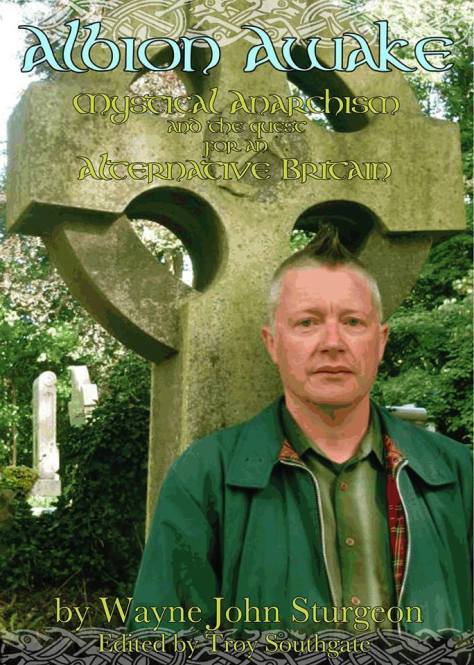
Anarchy, Faith, and Tradition: A Review of Wayne John Sturgeon’s Albion Awake
The book is presently available at Amazon.Com
By Keith Preston
Decades ago, I became interested in the classical anarchist tradition rooted as it is in the works of such thinkers as Pierre Joseph Proudhon, Mikhail Bakunin, and Peter Kropotkin. The message of anarchism was powerful one, and even then I realized that the anarchists had not made their final stand in such places as Kronstadt and Barcelona. Instead, the philosophy of anarchism offered a glimpse into the future, perhaps the far distant future. However, from the earliest days of my exposure to anarchism, I realized that the state of the “movement” as it was and is in late modernity is hardly up to the task of challenging capitalism and the state. I instinctively understood that an ultimately successful anarchism would have to make its peace with the cultures, traditions, faiths, and folkways of ordinary people, rather than positioning itself as an enemy of all that common folk hold to be sacred. I likewise realized that such a daunting task would be a long time in the making.
Yet it would appear that such a moment has arrived in the form of Wayne John Sturgeon’s Albion Awake, published in 2014 by Black Front Press. Sturgeon is a veteran of the English left-wing anarchist scene, a Christian convert, and a proponent of a decentralized, libertarian folkish patriotism that is reminiscent of earlier thinkers ranging from Gustav Landauer to Johann Gottfried Herder, both of whom he claims as influences. Sturgeon’s knowledge of various libertarian, anarchist, and decentralist traditions is voluminous. He possesses an equally encyclopedic knowledge of the many variations of “third way” philosophies that propose an alternative to both state-capitalism and state-socialism, ranging from social credit to the Catholic Worker movement to guild socialism to anarcho-syndicalism.
To top it all off, Wayne John Sturgeon is also quite erudite in the many traditions of radical Christianity. He describes his own faith outlook as “Orthodox but not eastern, Catholic but not papal, and Anglican but not protestant.” Sturgeon’s Christian perspective is neither the shallow ecumenicalism of contemporary established churches nor the reactionary fundamentalism common in American evangelical circles or the right-wing authoritarianism found in some Catholic traditionalist camps. Instead, Sturgeon embraces a faith outlook that manages to be radical, traditional, progressive, and libertarian all at once.
Albion Awake is a profoundly nuanced work. Sturgeon provides a comprehensive discussion of a wide range of topics in this collection of eighteen essays. Among the subjects he touches on are British mythology, integralism, folk radicalism, free markets, statism, Gnosticism, counter-economics, national-anarchism, futurism, William Blake, and metaphysics. The figures cited in this work are as diverse as Proudhon, Tolkien, Tolstoy, Dorothy Day, C.S. Lewis, William Morris, George Orwell, Richard Hunt, and the Sex Pistols. Many luminaries from the worlds of anarchist and libertarian thought are referenced, as are those from various Christian traditions and folkish philosophies. Every page of this book contains fascinating nuggets of information.
As eclectic as Sturgeon’s outlook and analysis are, he does not hesitate to criticize the excesses of various political currents. He has no time for crude racism, fascism, neo-nazism or the left’s counterparts to these such as Stalinism, Maoism, or the “cultural Marxism” of present day Western leftists. He criticizes the global imperial pretensions of the New World Order while rejecting various camps that call for a counter-imperialism of their own. Among the various descriptions Sturgeon offers to characterize his own outlook are such balanced pronouncements as patriotist but not nationalist, socialist but not Marxist, libertarian but not capitalist, non-violent but not pacifist, and liberal but not politically correct. The book’s chapters explore many unusual byways of political theory, history, economics, and religion. A discussion of Murray Bookchin will appear on one page, of Murray Rothbard on another page, of national-syndicalism another page, and on still other pages Martin Heidegger, W.B. Yeats, or John Milton.
One of the key points that Albion Awake insists upon is the archaic nature of the left/right model of the political spectrum. Sturgeon recognizes that libertarians, decentralists, and anarchists, whatever the many differences among them, are properly situated on end of the spectrum, with fascists, communists, state-socialists and reactionary nationalists on the other end, and the liberal capitalist center situated in the middle. He also has no time for self-proclaimed “anarchists” who nevertheless engage in wantonly destructive violence or champion Marxist-inspired repression. Indeed, Sturgeon’s work provides a blueprint for what genuinely radical populist movements organized in opposition to the neo-liberalism and totalitarian humanism of the establishment might look like.
Sturgeon’s thought is representative of what a mature anarchism might be. In recent decades, various European nations have witnessed the socialist and labor parties becoming completely absorbed by neo-liberalism. Meanwhile, frustrations with mass immigration, political correctness, and a loss of national sovereignty to the bureaucratic expanse of the European Union have triggered the rise of various populist-nationalist parties. Yet these parties typically offer virtually nothing other than a return to the status quo as it was before the 1990s. In place of such a mundane program, Sturgeon offers a revolutionary outlook that is authentically far sighted yet is not the sort of thing one might feel they have to hide in a brown paper bag. This is not a radicalism of smashed windows and inane slogans, or outmoded Marxist clichés, politically correct self-parody, flag-burning, and FEMEN. This is a radicalism that one may introduce to a wide cross section of one’s peer from all walks of life.
Wayne John Sturgeon’s amazing ability to synthesize left, right, anti-capitalist, decentralist, ecological and libertarian ideals in a way that is appreciative of traditional culture, ethnicity, faith, community, and family is a much needed addition to the anarchist canon. Contemporary anarchism has spent much of its energy attempting to appeal to the most extreme elements of the left or the most marginal subcultures. Somewhere along the way the question of “What about most people?” seemingly got lost. When the day finally comes that a political realignment takes place bringing the decentralist forces into alliance against totalitarians everywhere, it is not unlikely that the work and thought of Wayne John Sturgeon will have made a significant contribution to such a turn of events.
Taking the ATS/NATA Philosophy and Strategy to the Next Level: Building the Pan-Secessionist Meta-Party
By Keith Preston
In the essay, “Liberty and Populism: Building an Effective Resistance Movement for North America,” written in 2006, I made the following observation:
Since the above was written, at least two proposals have been put forward concerning how the type of meta-party described above might be organized and what it’s orientation might be. The most elaborate plan of this kind has been advanced by Ryan Faulk’s All Nations Party. The ANP is a proposed pan-secessionist party that would have ethnic separatism as its primary, though not necessarily exclusive, orientation. Another such proposal is Joe Kopsick’s Pananarchist Party USA, which seeks to advance the concept of non-territorial governments within a general individualist anarchist framework. While both proposals are a commendable efforts to open dialogue and engage in strategic formulation on this question, in both instances there might also be a bit of overreach.
Twenty-five percent of the US population currently expresses at least casual sympathy for the idea of a secessionist movement in their own region or locality. The principle objective for those of us who have embraced the pan-secessionist strategy should at this point be the awakening of this sleeping giant. The question is how to we turn this mass of 80 million passive sympathizers into a mass of active sympathizers? The first thing that should be recognized is that most of these 80 million potential constituents are not adherents of extremist or exotic ideologies. Instead, the bulk of the opinions held by these people are likely to be rather close to the mainstream on most issues.
There is no evidence that there is a sizable constituency for ethnic separatism within any ethnic group. To be sure, there is a tiny but outspoken minority of people within all ethnic groups who advocate for ethnic separatism, but the sum total of all ethnic separatists within all ethnic groups would still be a tiny fraction of the 320 million people who make up the US population. It is also true that there are many people who practice de facto ethnic separatism, but this largely reflects the economic and lifestyle choices of individuals, and is a far cry from advocating de jour ethnic separatism as a matter of ideology or moral conviction. While it is certainly true that ethnic separatists can also be pan-secessionists, it is unlikely that a pan-secessionist meta-party (PSMP) that advances ethnic separatism as a primary value will win a great deal of sympathy.
Likewise, it is unlikely that a PSMP that is primarily oriented towards the promotion of an esoteric or exotic ideology will gain much of an audience. While there are certainly plenty of historical precedents for such concepts as non-territorial governments, such ideas are also culturally alien to the overwhelming majority of persons in North America. Therefore, it would be unwise to adopt an ideological stance of this kind as principal strategic objective.
However, the concept of secession maintains very powerful roots within mainstream American history, culture, and politics for reasons that are too obvious to require discussion. Further, secession is a tactical concept that can be embraced by movements of any ideological, cultural, ethnic, religious, or economic orientation. How then should a PSMP organize itself?
The All Nations Party idea of a PSMP that functions as a umbrella for a set of constituent parties and regional or local secessionist movements that have their own interests is generally a solid one. However, I would suggest that at the meta-party level the PSMP should have only two stated objectives:
1. Promoting, advocating, legitimizing, and legalizing the right of secession by regions and localities from larger governmental units.
2. Promoting, advocating, legitimizing, and legalizing the right of minor parties to participate in public elections against the present two-party duopoly.
From this basic starting point, the constituent parties and secessionist movements associated with the PSMP would have every right to advocate for whatever philosophies or issues they wished. For example, the PSMP would have no position on foreign policy. If a collection of red state secessionists wished for the red states to go to war with ISIS, then so be it. The PSMP would have no position on economics. Presumably, for example, there would be both advocates of socialism and capitalism within the PSMP. The PSMP would exist only for the purpose of defending the rights of constituent groups to form their own parties or secessionist movements advocating for any ideas that they wished, and to strip away political and legal barriers to both competition in public elections by minor parties and secession by regionalist movements. This is does not in any way mean that any constituent party, organization, or movement of the PSMP would abandon or even downplay any of its other issues. It simply means that the PSMP would provide an organizational umbrella for the advancement of the interests of all minor parties and secessionist movements at the collective level. Within the framework of the PSMP, socialists would still advocate for single-payer healthcare, libertarians for tax cuts, social conservatives for the pro-life cause, and social leftists for LGBT issues. The PSMP would no doubt include many constituencies who were otherwise antithetical to each other, such as the Prohibition Party and the U.S. Marijuana Party.
In this sense, it must be understood that the PSMP would maintain both macro-level constituencies and micro-level constituencies. At the macro-level, the PSMP would have only two constituencies: the 25% and growing number of Americans who sympathize with the idea of secession, and those who prefer alternatives to the two-party duopoly. At the macro-level, the PSMP would exist only to promote the two issues of third party rights and secessionist rights, and these issues would be promoted in the same way that proponents of marijuana legalization, gay marriage, gun rights, gun control, the right-to-life or abortion rights have promoted their own issues. At the micro-level, the PSMP would have many constituencies, i.e. the constituencies of its component parties, organizations, movements, and the issues raised by each of these. Obviously, the opportunity would arise within such a scenario for a infinite variety of conflicts between the various constituents of the PSMP, and such conflicts are to be expected. Therefore, mutual agreements among the PSMP constituents would have to be formulated in order to maintain the common peace to the greatest degree reasonably possible. The most practical approach would be for the various constituent forces to simply agree to stay out of each other’s backyards. For example, the constituents forces that trended rightward would agree to focus their organizing and recruiting activities on the “red” demographic sectors of the US, and the forces that trended leftward would agree orient themselves towards organizing among the “blue” sectors.
At the national level, the presidential candidates of the PSMP would run solely on the two core principles of the PSMP: advocating for the rights of third parties, and the rights of secessionists. Preferably, the presidential ticket would be split between the Left and Right. For example, the presidential candidate might be from the Socialist Party or the Green Party, while the vice-presidential candidate would be from the Libertarian or Constitution Parties. Further, the Left/Right split ticket should be reversed every four years. For example, in the 2016 election the presidential candidate might be from the Left with the vice-presidential candidate might be from the Right. In 2020, the presidential candidate would then be from the Right while the vice-presidential candidate would be from the Left.
All other candidates of the PSMP would run on joint tickets of both the PSMP and their respective constituent parties. For example, the candidate for the governorship of Massachusetts might run on the tickets both the PSMP and the Socialist Action Party, and a comparable candidate in Texas might run on the tickets of both the PSMP and the Objectivist Party. Once again, in order to avoid overlap, rival constituent parties and organizations would mutually agree to stay out of each others backyards. Additionally, the candidates from minor parties and secessionist movements might also be combined at times. For example, a candidate in Georgia might stand simultaneously for the PSMP, Constitution Party and the League of the South, while a candidate in Oregon might stand for the PSMP, Green Party and Cascadia.
An approach of the kind that has been outlined above would serve multiple purposes. One would be to simply awaken the sleeping giant of potential secessionist sympathies among one-quarter of the U.S. population, and to challenge the Democratic-Republican two-party duopoly. Yet another would be to create a forum where many different kinds of people with otherwise opposed philosophies would be able to work with one another against the common enemy. A third would be to create a prototype for the kind of system that might exist following the inevitable demise of the present system, a decentralized system based on the principal of self-determination for all.
Of course, the emergence of a PSMP of the kind described above would also receive a great deal of criticism from a variety of sources. The critics would include ideologues and sectarians of both the left and right, the professional anti-rightist cottage industry, anti-leftists of a comparable nature, avowed statists and totalitarians, neoconservatives, jingoists, the party hacks of the system’s parties, their kept media, and, of course, the overlords of the system themselves. So be it. Revolutionaries without enemies are not revolutionaries at all.
Of course, some from the general anarchist milieus will object that party politics is antithetical to the wider anarchist values of rejection of the state. I previously address this question in “Liberty and Populism,”:
The general demographic and electoral base of the PSMP would be that which has previously been outlined in “Liberty and Populism,” though periodically modified in order to adapt to changing trends. The PSMP would then emerge as a populist alternative political force perhaps comparable to Italy’s Five Star Movement, or the recently formed coalition in Greece between Syriza and the Independent Greeks. There is also the further possibility of the PSMP embedding itself in the major parties on the ground level. For example, Norman Mailer’s secessionist “left-conservative” Democratic candidacy for mayor of New York in 1969 is one example, and Larry Kilgore’s secessionist conservative Christian Republican candidacy for Senator from Texas in 2008 is another example.
The PSMP and the Pan-Anarchist Movement
Within the context of the PSMP, the pan-anarchist movement would then work to advance its wider body of strategic and political ideas such as core demographic theory, fourth generation warfare, libertarian populism, inside/outside strategy, left/right/center tripartite strategy, alternative infrastructure, cultural organizations that would replace the state’s social infrastructure, the 25 point platform, building coalitions of anti-state interest groups, a peoples’ economic front, legal defense organizations, civilian defense organizations,expanded cop watch and neighborhood watch programs, tax protests, civil disobedience campaigns, Kevin Carson’s “political program for anarchists,” Larry Gambone’s “populist groundswell” and decentralist economics, a coalition against consensual crimes, a prisoner amnesty movement, a libertarian common law system, a Norwegian approach to criminology, a Swedish or Swiss approach to foreign policy, the city-state system, and much else.
Once again, none of this meta-political or meta-strategic program implies that any of the myriad of anarchist, libertarian, anti-statist, anti-authoritarian, or decentralist factions would abandon their preferred issues. As I wrote in “Philosophical Anarchism and the Death of Empire” concerning the concept of “anarcho-populism”:
The main thing that is needed as this point is action. It is necessary for activists to step forward and being applying the ideas that have been outined above. How did other movements that have achieved a great deal of success, or at least size and recognition, begin? How did the marijuana legalization movement being? The gay marriage movement? The Tea Parties? The anti-Vietnam War movement? The civil rights movement? The religious right? The modern American conservative movement? Surely, there are things that can be learned from each of these.
In the essay, “Liberty and Populism: Building an Effective Resistance Movement for North America,” written in 2006, I made the following observation:
Ultimately, we may at some point be able to combine the Green, Libertarian, Populist, Constitution, Natural Law and other minor parties into a single party,… I would suggest calling such a party the “Federalist Party” for several reasons. First, there is precedent for this from American history. Second, it accurately describes what the internal structure of the party should be. Third, it provides a model for the general types of institutional arrangements we should seek to develop. Perhaps our party flag could be an anarchist black flag with the snake from the “don’t tread on me” Gadsen battle flag embroidered on it.It is now time to begin the application of the core strategic ideas outlined in such ARV-ATS documents and “Liberty and Populism” and “Philosophical Anarchism and the Death of Empire.”
Since the above was written, at least two proposals have been put forward concerning how the type of meta-party described above might be organized and what it’s orientation might be. The most elaborate plan of this kind has been advanced by Ryan Faulk’s All Nations Party. The ANP is a proposed pan-secessionist party that would have ethnic separatism as its primary, though not necessarily exclusive, orientation. Another such proposal is Joe Kopsick’s Pananarchist Party USA, which seeks to advance the concept of non-territorial governments within a general individualist anarchist framework. While both proposals are a commendable efforts to open dialogue and engage in strategic formulation on this question, in both instances there might also be a bit of overreach.
Twenty-five percent of the US population currently expresses at least casual sympathy for the idea of a secessionist movement in their own region or locality. The principle objective for those of us who have embraced the pan-secessionist strategy should at this point be the awakening of this sleeping giant. The question is how to we turn this mass of 80 million passive sympathizers into a mass of active sympathizers? The first thing that should be recognized is that most of these 80 million potential constituents are not adherents of extremist or exotic ideologies. Instead, the bulk of the opinions held by these people are likely to be rather close to the mainstream on most issues.
There is no evidence that there is a sizable constituency for ethnic separatism within any ethnic group. To be sure, there is a tiny but outspoken minority of people within all ethnic groups who advocate for ethnic separatism, but the sum total of all ethnic separatists within all ethnic groups would still be a tiny fraction of the 320 million people who make up the US population. It is also true that there are many people who practice de facto ethnic separatism, but this largely reflects the economic and lifestyle choices of individuals, and is a far cry from advocating de jour ethnic separatism as a matter of ideology or moral conviction. While it is certainly true that ethnic separatists can also be pan-secessionists, it is unlikely that a pan-secessionist meta-party (PSMP) that advances ethnic separatism as a primary value will win a great deal of sympathy.
Likewise, it is unlikely that a PSMP that is primarily oriented towards the promotion of an esoteric or exotic ideology will gain much of an audience. While there are certainly plenty of historical precedents for such concepts as non-territorial governments, such ideas are also culturally alien to the overwhelming majority of persons in North America. Therefore, it would be unwise to adopt an ideological stance of this kind as principal strategic objective.
However, the concept of secession maintains very powerful roots within mainstream American history, culture, and politics for reasons that are too obvious to require discussion. Further, secession is a tactical concept that can be embraced by movements of any ideological, cultural, ethnic, religious, or economic orientation. How then should a PSMP organize itself?
The All Nations Party idea of a PSMP that functions as a umbrella for a set of constituent parties and regional or local secessionist movements that have their own interests is generally a solid one. However, I would suggest that at the meta-party level the PSMP should have only two stated objectives:
1. Promoting, advocating, legitimizing, and legalizing the right of secession by regions and localities from larger governmental units.
2. Promoting, advocating, legitimizing, and legalizing the right of minor parties to participate in public elections against the present two-party duopoly.
From this basic starting point, the constituent parties and secessionist movements associated with the PSMP would have every right to advocate for whatever philosophies or issues they wished. For example, the PSMP would have no position on foreign policy. If a collection of red state secessionists wished for the red states to go to war with ISIS, then so be it. The PSMP would have no position on economics. Presumably, for example, there would be both advocates of socialism and capitalism within the PSMP. The PSMP would exist only for the purpose of defending the rights of constituent groups to form their own parties or secessionist movements advocating for any ideas that they wished, and to strip away political and legal barriers to both competition in public elections by minor parties and secession by regionalist movements. This is does not in any way mean that any constituent party, organization, or movement of the PSMP would abandon or even downplay any of its other issues. It simply means that the PSMP would provide an organizational umbrella for the advancement of the interests of all minor parties and secessionist movements at the collective level. Within the framework of the PSMP, socialists would still advocate for single-payer healthcare, libertarians for tax cuts, social conservatives for the pro-life cause, and social leftists for LGBT issues. The PSMP would no doubt include many constituencies who were otherwise antithetical to each other, such as the Prohibition Party and the U.S. Marijuana Party.
In this sense, it must be understood that the PSMP would maintain both macro-level constituencies and micro-level constituencies. At the macro-level, the PSMP would have only two constituencies: the 25% and growing number of Americans who sympathize with the idea of secession, and those who prefer alternatives to the two-party duopoly. At the macro-level, the PSMP would exist only to promote the two issues of third party rights and secessionist rights, and these issues would be promoted in the same way that proponents of marijuana legalization, gay marriage, gun rights, gun control, the right-to-life or abortion rights have promoted their own issues. At the micro-level, the PSMP would have many constituencies, i.e. the constituencies of its component parties, organizations, movements, and the issues raised by each of these. Obviously, the opportunity would arise within such a scenario for a infinite variety of conflicts between the various constituents of the PSMP, and such conflicts are to be expected. Therefore, mutual agreements among the PSMP constituents would have to be formulated in order to maintain the common peace to the greatest degree reasonably possible. The most practical approach would be for the various constituent forces to simply agree to stay out of each other’s backyards. For example, the constituents forces that trended rightward would agree to focus their organizing and recruiting activities on the “red” demographic sectors of the US, and the forces that trended leftward would agree orient themselves towards organizing among the “blue” sectors.
At the national level, the presidential candidates of the PSMP would run solely on the two core principles of the PSMP: advocating for the rights of third parties, and the rights of secessionists. Preferably, the presidential ticket would be split between the Left and Right. For example, the presidential candidate might be from the Socialist Party or the Green Party, while the vice-presidential candidate would be from the Libertarian or Constitution Parties. Further, the Left/Right split ticket should be reversed every four years. For example, in the 2016 election the presidential candidate might be from the Left with the vice-presidential candidate might be from the Right. In 2020, the presidential candidate would then be from the Right while the vice-presidential candidate would be from the Left.
All other candidates of the PSMP would run on joint tickets of both the PSMP and their respective constituent parties. For example, the candidate for the governorship of Massachusetts might run on the tickets both the PSMP and the Socialist Action Party, and a comparable candidate in Texas might run on the tickets of both the PSMP and the Objectivist Party. Once again, in order to avoid overlap, rival constituent parties and organizations would mutually agree to stay out of each others backyards. Additionally, the candidates from minor parties and secessionist movements might also be combined at times. For example, a candidate in Georgia might stand simultaneously for the PSMP, Constitution Party and the League of the South, while a candidate in Oregon might stand for the PSMP, Green Party and Cascadia.
An approach of the kind that has been outlined above would serve multiple purposes. One would be to simply awaken the sleeping giant of potential secessionist sympathies among one-quarter of the U.S. population, and to challenge the Democratic-Republican two-party duopoly. Yet another would be to create a forum where many different kinds of people with otherwise opposed philosophies would be able to work with one another against the common enemy. A third would be to create a prototype for the kind of system that might exist following the inevitable demise of the present system, a decentralized system based on the principal of self-determination for all.
Of course, the emergence of a PSMP of the kind described above would also receive a great deal of criticism from a variety of sources. The critics would include ideologues and sectarians of both the left and right, the professional anti-rightist cottage industry, anti-leftists of a comparable nature, avowed statists and totalitarians, neoconservatives, jingoists, the party hacks of the system’s parties, their kept media, and, of course, the overlords of the system themselves. So be it. Revolutionaries without enemies are not revolutionaries at all.
Of course, some from the general anarchist milieus will object that party politics is antithetical to the wider anarchist values of rejection of the state. I previously address this question in “Liberty and Populism,”:
Some anarchists will no doubt object that my approach reeks far too much of a reformist/electoralist outlook. While I certainly respect this point of view, I believe it is unnecessarily sectarian and archaic. The classical anarchists often advocated boycotting elections and for good reason. In most of the countries where the classical anarchist movement existed on a scale of any significance, the “right to vote” was either non-existent or the franchise was very limited. Even in nominal democracies like Switzerland and America, women and other large population groups were denied the vote. Even at that, many Spanish villages elected anarchist mayors and village councils in the years leading up to the civil war. I believe modern anarchists need to develop an approach to this question that is relevant to the nature of modern states and modern societies. The approach I favor is one of cold realism and pragmatism. It is indeed possible for ordinary people with conventional levels of resources to be elected to local and state offices in many parts of the US. Persons who achieve some level of success in this area are then in a position to influence appointments to other positions of influence. This can be very important as a means of keeping the worst elements away from seats of power.It should also be pointed out that the PSMP would be merely a means to an end, and not an end unto itself. It would merely be a vehicle for promoting and popularizing a wider subversive agenda. Further, it would create a framework that would allow anarchists to reach out to and connect with people from all over the cultural and political spectrum, and experience the opportunity to work with a vast array of dissidents as equal partners towards common goals. Anarchists would would have the opportunity to embed themselves in the PSMP for the purpose of pursuing a more radical line and the advancement of more extraneous issues that are among the unique concerns of anarchists. Just as the myriad of constituent parties and movements of the PSMP would maintain their own objectives, and pursue those objectives within other contexts, so would anarchists do the same. Specifically, anarchists might concentrate their own efforts on local politics, and strive for the achievement of political preeminence in an increasingly greater number of cities, towns, and counties. Two, three, many Christianias, Marinaledas, Mondragons, and Kobanis could begin to proliferate. Meanwhile, the prototypes of South Africa’s conservative Orania community and Liechtenstein’s libertarian monarchical micro-nation provide models of how Anarchists and the Left might peacefully co-exist with the Right. Further, there might be a parallel pan-anarchist federation that co-exists with the PSMP, and functions as a base of activists and organizers for the PSMP. The relationship between the pan-anarchist federation and the PSMP would be comparable to the relationship between the FAI, the CNT, and the Anti-Fascist militias during the period of Revolutionary Spain.
The general demographic and electoral base of the PSMP would be that which has previously been outlined in “Liberty and Populism,” though periodically modified in order to adapt to changing trends. The PSMP would then emerge as a populist alternative political force perhaps comparable to Italy’s Five Star Movement, or the recently formed coalition in Greece between Syriza and the Independent Greeks. There is also the further possibility of the PSMP embedding itself in the major parties on the ground level. For example, Norman Mailer’s secessionist “left-conservative” Democratic candidacy for mayor of New York in 1969 is one example, and Larry Kilgore’s secessionist conservative Christian Republican candidacy for Senator from Texas in 2008 is another example.
The PSMP and the Pan-Anarchist Movement
Within the context of the PSMP, the pan-anarchist movement would then work to advance its wider body of strategic and political ideas such as core demographic theory, fourth generation warfare, libertarian populism, inside/outside strategy, left/right/center tripartite strategy, alternative infrastructure, cultural organizations that would replace the state’s social infrastructure, the 25 point platform, building coalitions of anti-state interest groups, a peoples’ economic front, legal defense organizations, civilian defense organizations,expanded cop watch and neighborhood watch programs, tax protests, civil disobedience campaigns, Kevin Carson’s “political program for anarchists,” Larry Gambone’s “populist groundswell” and decentralist economics, a coalition against consensual crimes, a prisoner amnesty movement, a libertarian common law system, a Norwegian approach to criminology, a Swedish or Swiss approach to foreign policy, the city-state system, and much else.
Once again, none of this meta-political or meta-strategic program implies that any of the myriad of anarchist, libertarian, anti-statist, anti-authoritarian, or decentralist factions would abandon their preferred issues. As I wrote in “Philosophical Anarchism and the Death of Empire” concerning the concept of “anarcho-populism”:
Hence, what I am proposing is a new strategic paradigm and, to a certain extent, a new school of anarchist thought that I call “anarcho-populism”. This new brand of anarchism would draw on the other schools in various ways. The classical anarchism originally developed by Proudhon would be its foundation. Like anarcho-socialism, anarcho-populism would be anti-capitalist and pro-class struggle. Like anarcho-capitalism, anarcho-populism would endorse property, markets and the independent sector as an antidote to statism, corporatism and welfarism. Along with leftist-anarchists, this new anarchist tendency would support political freedom and cultural self-determination for racial minorities, women, gays and the like but would not seek to mindlessly glorify or privilege these groups or demonize white males. Along with primitivists and eco-anarchists, anarcho-populism would seek to preserve the natural environment, but without the misanthropy and anti-tech hysteria of much modern environmentalism. Like national-anarchists, anarcho-populism would endorse the right of traditional racial, ethnic, religious or cultural groups to self-preservation and political sovereignty and cross-cultural, cross-ideological alliances against the NWO, but would seek to branch out into “mainstream” society rather than seek out reclusive isolation from the modern world.Presumably, every libertarian faction would continue to focus on its primary areas of concern, from sovereign citizens to anarcha-feminists, and every faction could maintain its own sub-organizational identities within the context of the pan-anarchist federation as well. However, organizing and advancing the PSMP might serve as a common project and rallying point for all libertarian factions.
The main thing that is needed as this point is action. It is necessary for activists to step forward and being applying the ideas that have been outined above. How did other movements that have achieved a great deal of success, or at least size and recognition, begin? How did the marijuana legalization movement being? The gay marriage movement? The Tea Parties? The anti-Vietnam War movement? The civil rights movement? The religious right? The modern American conservative movement? Surely, there are things that can be learned from each of these.
Tuesday, February 24, 2015
Anarchists vs. ISIS: The Revolution in Syria Nobody’s Talking About
Via; Cult Nation
by Gareth Watkins February 6, 2015
The Middle East today is the last place anyone in mainstream western thought would think to look for progressive political thought, and even less to see those thoughts translated into action. Our image of the region is one of dictatorships, military juntas and theocracies built on the ruins of the former Ottoman Empire, or hollow states like Afghanistan, and increasingly Pakistan, where anything outside the capitol is like Mad Max. The idea of part of the region being not just free, but well on its way to utopian, isn't one that you're going to find on mainstream media.
But you're not on the mainstream media right now, are you?
Along Syria's borders with Turkey and Northern Iraq, lies a mainly Kurdish area with a population of 4.6 million where a huge social experiment is taking place at the centre of a crossfire between Syria's dictatorship, ISIS's collective insanity and Turkey's ongoing hostility towards the idea of Kurdish autonomy, with the US and NATO looming large in the background. The Democratic Union Party (PYD) and Kurdish National Council (KNC) established in the region of Rojava a society that mixes fierce libertarianism (guns are everywhere and there are no taxes – none) and Occupy-friendly anarchist thought with a healthy dose of feminism. While most Kurdish groups, especially those the US is friendly with, would some day like to establish a Kurdish state, in Rojava they have leap-frogged over the idea of the nation state into a more advanced system that they call Democratic Confederalism.

In the cantons of Rojava, there is a small central government with an absolute minimum of 40% female delegates, but most of the day-to-day work of running society happens at a local level, street by street and village by village. Democratic Confederalism's chief architect, Abdullah Ocalan, says that “Ecology and feminism are central pillars” of the system he has spearheaded, something that you would have to go very far to the margins to hear from Western politicians. In Rojava, men who beat their wives face total ostracism from the community, making their lives in a highly social, connected society virtually impossible. Instead of a police force and jails, 'peace committees' in each municipality work to defuse the cycles of inter-family revenge killings by consensual agreements between both sides – and it works.
The only part of Rojava's experiment that has received any international attention has been the YPJ, the female-only paramilitary forces that have been fighting, and winning, against ISIS and the Syrian Army. NBC, the Guardian and even Marie Claire have all covered the YPJ's bravery without even paying lip service to the ideology that makes it possible.
It was the YPJ, along with their male counterparts the YPG, that rescued the thousands of Yazidis stranded and encircled by ISIS on Mount Sinjar in northern Iraq. The Yazidi community had the misfortune to be based almost entirely inside the area that ISIS has claimed – and they have been a hated minority in the Islamic world for a thousand years, accused of 'devil worship'. While the US dropped supplies from above, the Syrian fighting groups broke ISIS's lines and saved tens of thousands of lives. They also successfully defended the city of Kobani when ISIS launched an all-out assault on the city of forty-five thousand with tanks, missiles and even drones. Despite heavy losses, the city remains ISIS-free, though its surrounding villages are still contested.

The YPJ/G and the the Democratic Society Movement that they fight for aren't perfect: they have been accused of using child soldiers (girls as young as twelve serve as cooks and cleaners for the YPJ and undergo some basic combat training, though they aren't deployed in combat) and they are forever tainted by their association with the Kurdistan Workers Party (PKK), led by Abdullah Ocalan and classified as a terrorist organization by most nations. The formerly Marxist-Leninist party also has some murky connections to the drug trade and Turkish intelligence.
Despite all the obstacles facing them, the people of Rojava are, right now, the only large-scale movement on the entire planet implementing a real, working alternative to the state and capitalism. Like the Spanish anarchist federations and the Mexican Zapatistas before them, the people of Rojava have chosen to do the impossible: to create a new society while fighting as one of the smallest forces in a regional war, a tight-rope walk through a dodge-ball court. Only time will tell if they can pull it off.
by Gareth Watkins February 6, 2015
Photos: Erin Trieb
The Middle East today is the last place anyone in mainstream western thought would think to look for progressive political thought, and even less to see those thoughts translated into action. Our image of the region is one of dictatorships, military juntas and theocracies built on the ruins of the former Ottoman Empire, or hollow states like Afghanistan, and increasingly Pakistan, where anything outside the capitol is like Mad Max. The idea of part of the region being not just free, but well on its way to utopian, isn't one that you're going to find on mainstream media.
But you're not on the mainstream media right now, are you?
Along Syria's borders with Turkey and Northern Iraq, lies a mainly Kurdish area with a population of 4.6 million where a huge social experiment is taking place at the centre of a crossfire between Syria's dictatorship, ISIS's collective insanity and Turkey's ongoing hostility towards the idea of Kurdish autonomy, with the US and NATO looming large in the background. The Democratic Union Party (PYD) and Kurdish National Council (KNC) established in the region of Rojava a society that mixes fierce libertarianism (guns are everywhere and there are no taxes – none) and Occupy-friendly anarchist thought with a healthy dose of feminism. While most Kurdish groups, especially those the US is friendly with, would some day like to establish a Kurdish state, in Rojava they have leap-frogged over the idea of the nation state into a more advanced system that they call Democratic Confederalism.

In the cantons of Rojava, there is a small central government with an absolute minimum of 40% female delegates, but most of the day-to-day work of running society happens at a local level, street by street and village by village. Democratic Confederalism's chief architect, Abdullah Ocalan, says that “Ecology and feminism are central pillars” of the system he has spearheaded, something that you would have to go very far to the margins to hear from Western politicians. In Rojava, men who beat their wives face total ostracism from the community, making their lives in a highly social, connected society virtually impossible. Instead of a police force and jails, 'peace committees' in each municipality work to defuse the cycles of inter-family revenge killings by consensual agreements between both sides – and it works.
The only part of Rojava's experiment that has received any international attention has been the YPJ, the female-only paramilitary forces that have been fighting, and winning, against ISIS and the Syrian Army. NBC, the Guardian and even Marie Claire have all covered the YPJ's bravery without even paying lip service to the ideology that makes it possible.
It was the YPJ, along with their male counterparts the YPG, that rescued the thousands of Yazidis stranded and encircled by ISIS on Mount Sinjar in northern Iraq. The Yazidi community had the misfortune to be based almost entirely inside the area that ISIS has claimed – and they have been a hated minority in the Islamic world for a thousand years, accused of 'devil worship'. While the US dropped supplies from above, the Syrian fighting groups broke ISIS's lines and saved tens of thousands of lives. They also successfully defended the city of Kobani when ISIS launched an all-out assault on the city of forty-five thousand with tanks, missiles and even drones. Despite heavy losses, the city remains ISIS-free, though its surrounding villages are still contested.

The YPJ/G and the the Democratic Society Movement that they fight for aren't perfect: they have been accused of using child soldiers (girls as young as twelve serve as cooks and cleaners for the YPJ and undergo some basic combat training, though they aren't deployed in combat) and they are forever tainted by their association with the Kurdistan Workers Party (PKK), led by Abdullah Ocalan and classified as a terrorist organization by most nations. The formerly Marxist-Leninist party also has some murky connections to the drug trade and Turkish intelligence.
Despite all the obstacles facing them, the people of Rojava are, right now, the only large-scale movement on the entire planet implementing a real, working alternative to the state and capitalism. Like the Spanish anarchist federations and the Mexican Zapatistas before them, the people of Rojava have chosen to do the impossible: to create a new society while fighting as one of the smallest forces in a regional war, a tight-rope walk through a dodge-ball court. Only time will tell if they can pull it off.
Sunday, January 11, 2015
Libertarian Welfare Queens
By MK Lords
Lately, I’ve been getting tired of the same old scams coming from the same old people in the libertarian “movement”. Many OG libertarians I’ve spoken with agree, so I thought I’d compile a list of popular but parasitic libertarians. It turns out libertarians and ancaps are some of the worst capitalists ever. Despite raging against tax payer supported “welfare queens” there seems to be quite a lot of libertarians fighting for the ever depleting capital flowing from the chapped teat that holds the earnings of fellow libertarians.
Libertarians employ a variety of tactics to spread their message, but a tactic I must disagree with is begging for money from people in your movement for stunts that are utopian at best and ineffective or dangerous at worst.
Libertarians also have an aversion to critiquing fellow libertarians because of the small scope and influence the philosophy currently has and because many of them feel it would harm the movement. Any movement worth its salt can stand criticism of its members, and if it can’t then it’s not worth being a part of to begin with.
I’ve been distancing myself from the label libertarian for some time now because I hate echo chambers and increasingly felt being pulled into one. My news feed has slowly but surely become filled with the same slogans, the same news stories, the same solutions, the same begging, even the same fake names! Criticism is shot down with paranoid accusations of concern trolling or even of being a Fed. Yawn. Dissidence is not allowed and any half-assed attempt at activism by a “celebritarian” is venerated as groundbreaking. Thousands of dollars get thrown at “activists” who have disappeared other thousands with little explanation. Critiques of thought leaders are brushed away with the weak argument, “But such and such did sooooo much for liberty in the past!!!” as if it matters.
Redirecting capital to effective, peaceful, free market solutions could do wonders for human progress and I support a diversity of tactics approach to solving social problems. That doesn’t mean I believe all tactics are equally effective. It’s important to ask hard questions of charismatic leaders and press even harder when they evade. Living off of the charity of people in your own movement while arguing for capitalism seems oxymoronic especially when you keep ignoring market responses to your work.
I am not a part of the “liberty movement” though people still try to get me to add it to my work description on the Facebook. Do I promote the ideas of liberty? Sure–I’ve done several podcasts and am even a co-host on a libertarian themed radio show. But it’s because I want liberty for myself; I have no illusions about achieving freedom for mankind and sacrificing myself for the greater cause of liberty to the point of financial hardship. News flash: you can be an activist and have a job. And you can even be an effective full time activist. I like the idea of free markets but ultimately I’m an individualist anarchist if you must label it. The religiosity of some libertarians is off-putting. They criticize nonbelievers for being “brainwashed sheep” as they parrot the words of their own deities who unfortunately range from the scholarly to the deranged. They also cry a lot about not having the capital of other movements as if it’s a mystery where it’s going.
Sorry, but you guys wasted it on libertarian welfare queens.
A libertarian welfare queen is a prominent libertarian who lives off the donations of other libertarians but produces content that is factually incorrect, manipulative, embarrassing, threatening, and oftentimes ineffective or counterproductive. They are the leeches who are somehow able to keep raising money despite questionable practices in their activism and whose serious ethical breaches are ignored or forgiven despite no attempt at restitution. The people named here are not the only ones in libertarianism I consider counterproductive, either.
But enough bitching, I’m gonna name a few libertarian welfare queens because I am so tired of this particular problem robbing well intentioned people who have jobs of their well-earned money. It’s also important to be able to laugh at the strange humans that try to lead you when you’re more than capable of leading yourself. I generally like libertarians, but there are a few bad apples, and I want to let others know so they don’t support jobless swindlers. Libertarian Welfare Queenism is a problem, but the solution is simple and voluntary.
(In no particular order)
First up is His Holiness Stefan Molyneux.

Known as Holy Moly by his detractors, this guy makes his money off of repackaging old philosophy and bad touching donor brains. I tried to like him, I really did, but he reminded me of my mother. His audience is mostly young men and women who, if true believers, have separated from their families on his advice (that is not to make light of child abuse, I do believe separation is appropriate in certain circumstances). The same advice that got his actual therapist wife fined and threatened with suspension. He also creeps on her clients which I’m pretty sure by any standard is a violation of privacy. Molyneux bullies listeners in precarious financial situations to send him money. And when I say bully, I mean he berates broke college kids over $1 donations. Like all good authoritarian figures, he’s blatantly hypocritical in applying his own philosophy. He caused some ruckus lately when he filed a DMCA take down claim on a critic despite claiming to be virulently anti-IP for years. His older videos provide simple, easily accessible arguments for anarcho-capitalism but his recent ones are riddled with misogyny and cop apologia. And I’m not one to throw the term misogyny around irresponsibly, but he likes to call women “estrogen based parasites” which is ironic given that his wife is the one with a real job and his living is subsidized by young people in an unstable economy.
He also uses classic manipulation techniques to lure listeners in such as immediately asking about their childhoods. This approach builds a façade of false trust and closeness. It’s disturbing to say the least and I’m genuinely pissed he does it to people I care about. This is in between bizarre outbursts about black kids who dare to smoke blunts and other black kids that have miraculously figured out how to make “lean” from tea and skittles. Who knew Trayvon was an alchemist?! Even worse is his belief that he is singlehandedly saving the world (“I am the ring of fire protecting the fragile tree of virtue” is an exact quote). His followers appear to be much smarter than him and it’s unfortunate he’s such an arse because I can agree that peaceful parenting is a great thing.
Also, despite complaints of donation decreases and claims his website takes “tens of thousands of dollars” to operate, dude is sitting pretty on a stack of bitcoin. Weird that the documentary he was hyping a few years ago still hasn’t been made…and no doubt his Paypal donations greatly exceed his bitcoin ones. He’s gonna need them for the lawsuit filed by his critic for shutting down her Youtube channel, so if you feel moved please find it in your heart to send him a few bits. Or you’re a thief.
The second offender would probably be proud to be called that, say hello to Christopher Cantwell.

Cantwell can’t do much well other than bloviate on his blog and beg for donations while doing everything in his power to offend people, which would be hilarious if he were funny but his career is a bad joke. (hyuckhyuckhyuck!) He calls himself a comedian but I’m pretty sure living in your mother’s basement well into your thirties is only funny as a libertarian stereotype not a reality. I wish I was lying about that last part, but it’s entirely true. Since he moved out of his mom’s, he likes long walks in downtown Keene harassing meter maids and bragging about how cool it is to kill cops. He’d be infinitely more interesting if he followed through but he never will because he is a huge coward. I’m usually the first one to say attack the argument not the man, but he’s called better people worse things and I assume (often to my surprise) if people can dish it they can take it.
He also likes to talk about how any publicity is good publicity as a coping mechanism to his humiliating appearance on The Colbert Report and generally pathetic existence. Finally, libertarians get that juicy mainstream coverage, but *spoiler alert* it’s an ogre with atrocious gun safety practices. Oh yeah, he wields guns like a giant retarded baby. Other sources say he knows his shit IRL but he somehow managed to appear in at least two videos violating basic gun safety rules so I remain skeptical. He’s one of those sacrificial full time activists which I assume means being an internet tough guy. You mean to tell me an able bodied middle aged man with what I assume is years of job experience can’t go get a job like the productive libertarians? Ok. This 3edgy5me welfare queen also helped Adam Kokesh organize a failed armed march on Washington, D.C. because getting a bunch of your supporters massacred sounded like a good idea at the time. Cantwell is that bully in school that talks a lot of shit but acts on none of it. Honestly, I don’t even think he’s siphoned that much money off of libertarians, but he’s embarrassing enough to make the list with his bitching about how he “desperately” needs donations. Get a job, Cantwell, the market has spoken.
Last on the list is everyone’s favorite freedom fighter, Adam Kokesh.

If there’s one person libertarians should stop sending any money to immediately, it’s this guy. Please, I implore you; stop sending money to him. For your own sake, for the sake of future generations, please just STAHP. Sure, the butthurt among you will say, “look at all he has done!!!1!11!!!” but the butthurt among you don’t realize homeboy is a trust fund kid. Maybe back in 2010, Kokesh had some good ideas if you ignore that he stole them from other activists. I know some of them personally, but I won’t name names because I respect them and know they don’t wish to start any trouble within libertarianism. He also has a nasty habit of not paying people who work for him which is pretty messed up considering how good he is at raising money.
Kokesh is a man notorious for raising large sums of money that disappears without a trace if not squandered on useless activism. This guy riled up a bunch of mentally unstable people to march on Washington D.C. with weapons—quite possibly the dumbest stunt I’ve ever heard of—then cancelled it. He followed it up by an even more half-baked stunt: literally standing in front of the White House and Capitol racking a shotgun. Kokesh, with thousands of dollars in film and effects equipment, chose to do that instead of using a fucking green screen and then goaded libertarians into supporting his defense team after he was unsurprisingly raided. He then bailed on a legit mutual defense agency while his close team members slandered George Donnelly’s good name despite George’s meticulous records proving shenanigans. Then, and this is rich, he blamed his buddies for the missing funds! That’s 50 grand down the memory hole, mind you. Donors whined and he got his poor girlfriend to give some half-assed explanation. Everyone promptly forgot and no lawsuit was filed. Then, as if that wasn’t enough for libertarians to at least question his judgment, he goes on a book tour to spread the good word of liberty! I can understand needing to hustle when you get out of jail, but dude got another $30,000 from people for this tour. After he and/or his team disappeared over $50,000. Re-read that last sentence until it really sinks in.
So it seems libertarians and their money are easily departed, but what stings worse is that this asshole doesn’t need their money. His father is a venture capitalist who memholed $45 million and according to confidential sources his mother bankrolls his lifestyle. If you think he doesn’t have a trust fund, you are out of your goddamned mind. I give him props for being the best ancap on this list because that’s kind of impressive that he can squeeze so much money out of broke people over and over again.
**Dishonorable mention: Ron Paul. Paul was originally on the list and I removed him because he did make his money except when he was campaigning and being a congressman. All I will say is don’t be surprised when the millions people donate to a failed political campaign are wasted on bribes. Did you really think politics was fair? Bless your heart.
Libertarian welfare queens are a drain on libertarianism and I think libertarians can do better. How can libertarian welfare queens ever hope to change the world if they can’t get past their entitled mindsets? How can libertarians ever inspire others to lead themselves if they’re still following these vermin?
Now there are still some scammers about that don’t quite make the list and activist methods I find are a waste of money even with the best of intentions, so here’s a litmus test if that money is burning a hole in your pocket. If any of the people on this list ask for money, don’t give it to them; if someone tells you there’s a Randian utopia waiting for you in Chile, don’t give them money (even if they have a team of cryptoanarchists ready to pounce); if someone says they are going to tour America spreading the good word of liberty, don’t give them money; if someone threatens to quit the “movement” because they’re not able to pay their bills as an activist, don’t give them money; if someone says they’re running for office, you know better than to give them money; if someone asks you to fund their anarcho-hippie commune, don’t give them money; if you’re a broke college kid, don’t give your money to anybody. If it sounds too good to be true it is and if it’s coming from a libertarian welfare queen it will probably be ham-fistedly executed.
Good ideas spread organically and now virally thanks to the internet, and despite a rough economy you can make money if you produce something valuable to others. There is no need to resort to older, more time consuming and expensive methods. Put your money where it matters and lead yourself. Or at the very least, do your due diligence on activists asking for money—there are some excellent projects out there by trustworthy people, but there are a lot of scammers too.
Lately, I’ve been getting tired of the same old scams coming from the same old people in the libertarian “movement”. Many OG libertarians I’ve spoken with agree, so I thought I’d compile a list of popular but parasitic libertarians. It turns out libertarians and ancaps are some of the worst capitalists ever. Despite raging against tax payer supported “welfare queens” there seems to be quite a lot of libertarians fighting for the ever depleting capital flowing from the chapped teat that holds the earnings of fellow libertarians.
Libertarians employ a variety of tactics to spread their message, but a tactic I must disagree with is begging for money from people in your movement for stunts that are utopian at best and ineffective or dangerous at worst.
Libertarians also have an aversion to critiquing fellow libertarians because of the small scope and influence the philosophy currently has and because many of them feel it would harm the movement. Any movement worth its salt can stand criticism of its members, and if it can’t then it’s not worth being a part of to begin with.
I’ve been distancing myself from the label libertarian for some time now because I hate echo chambers and increasingly felt being pulled into one. My news feed has slowly but surely become filled with the same slogans, the same news stories, the same solutions, the same begging, even the same fake names! Criticism is shot down with paranoid accusations of concern trolling or even of being a Fed. Yawn. Dissidence is not allowed and any half-assed attempt at activism by a “celebritarian” is venerated as groundbreaking. Thousands of dollars get thrown at “activists” who have disappeared other thousands with little explanation. Critiques of thought leaders are brushed away with the weak argument, “But such and such did sooooo much for liberty in the past!!!” as if it matters.
Redirecting capital to effective, peaceful, free market solutions could do wonders for human progress and I support a diversity of tactics approach to solving social problems. That doesn’t mean I believe all tactics are equally effective. It’s important to ask hard questions of charismatic leaders and press even harder when they evade. Living off of the charity of people in your own movement while arguing for capitalism seems oxymoronic especially when you keep ignoring market responses to your work.
I am not a part of the “liberty movement” though people still try to get me to add it to my work description on the Facebook. Do I promote the ideas of liberty? Sure–I’ve done several podcasts and am even a co-host on a libertarian themed radio show. But it’s because I want liberty for myself; I have no illusions about achieving freedom for mankind and sacrificing myself for the greater cause of liberty to the point of financial hardship. News flash: you can be an activist and have a job. And you can even be an effective full time activist. I like the idea of free markets but ultimately I’m an individualist anarchist if you must label it. The religiosity of some libertarians is off-putting. They criticize nonbelievers for being “brainwashed sheep” as they parrot the words of their own deities who unfortunately range from the scholarly to the deranged. They also cry a lot about not having the capital of other movements as if it’s a mystery where it’s going.
Sorry, but you guys wasted it on libertarian welfare queens.
A libertarian welfare queen is a prominent libertarian who lives off the donations of other libertarians but produces content that is factually incorrect, manipulative, embarrassing, threatening, and oftentimes ineffective or counterproductive. They are the leeches who are somehow able to keep raising money despite questionable practices in their activism and whose serious ethical breaches are ignored or forgiven despite no attempt at restitution. The people named here are not the only ones in libertarianism I consider counterproductive, either.
But enough bitching, I’m gonna name a few libertarian welfare queens because I am so tired of this particular problem robbing well intentioned people who have jobs of their well-earned money. It’s also important to be able to laugh at the strange humans that try to lead you when you’re more than capable of leading yourself. I generally like libertarians, but there are a few bad apples, and I want to let others know so they don’t support jobless swindlers. Libertarian Welfare Queenism is a problem, but the solution is simple and voluntary.
(In no particular order)
First up is His Holiness Stefan Molyneux.

h/t Bitcoin Not Bombs comrade Davi Barker for this gem
Known as Holy Moly by his detractors, this guy makes his money off of repackaging old philosophy and bad touching donor brains. I tried to like him, I really did, but he reminded me of my mother. His audience is mostly young men and women who, if true believers, have separated from their families on his advice (that is not to make light of child abuse, I do believe separation is appropriate in certain circumstances). The same advice that got his actual therapist wife fined and threatened with suspension. He also creeps on her clients which I’m pretty sure by any standard is a violation of privacy. Molyneux bullies listeners in precarious financial situations to send him money. And when I say bully, I mean he berates broke college kids over $1 donations. Like all good authoritarian figures, he’s blatantly hypocritical in applying his own philosophy. He caused some ruckus lately when he filed a DMCA take down claim on a critic despite claiming to be virulently anti-IP for years. His older videos provide simple, easily accessible arguments for anarcho-capitalism but his recent ones are riddled with misogyny and cop apologia. And I’m not one to throw the term misogyny around irresponsibly, but he likes to call women “estrogen based parasites” which is ironic given that his wife is the one with a real job and his living is subsidized by young people in an unstable economy.
He also uses classic manipulation techniques to lure listeners in such as immediately asking about their childhoods. This approach builds a façade of false trust and closeness. It’s disturbing to say the least and I’m genuinely pissed he does it to people I care about. This is in between bizarre outbursts about black kids who dare to smoke blunts and other black kids that have miraculously figured out how to make “lean” from tea and skittles. Who knew Trayvon was an alchemist?! Even worse is his belief that he is singlehandedly saving the world (“I am the ring of fire protecting the fragile tree of virtue” is an exact quote). His followers appear to be much smarter than him and it’s unfortunate he’s such an arse because I can agree that peaceful parenting is a great thing.
Also, despite complaints of donation decreases and claims his website takes “tens of thousands of dollars” to operate, dude is sitting pretty on a stack of bitcoin. Weird that the documentary he was hyping a few years ago still hasn’t been made…and no doubt his Paypal donations greatly exceed his bitcoin ones. He’s gonna need them for the lawsuit filed by his critic for shutting down her Youtube channel, so if you feel moved please find it in your heart to send him a few bits. Or you’re a thief.
The second offender would probably be proud to be called that, say hello to Christopher Cantwell.

Cantwell showing that piece of fabric who’s boss.
Cantwell can’t do much well other than bloviate on his blog and beg for donations while doing everything in his power to offend people, which would be hilarious if he were funny but his career is a bad joke. (hyuckhyuckhyuck!) He calls himself a comedian but I’m pretty sure living in your mother’s basement well into your thirties is only funny as a libertarian stereotype not a reality. I wish I was lying about that last part, but it’s entirely true. Since he moved out of his mom’s, he likes long walks in downtown Keene harassing meter maids and bragging about how cool it is to kill cops. He’d be infinitely more interesting if he followed through but he never will because he is a huge coward. I’m usually the first one to say attack the argument not the man, but he’s called better people worse things and I assume (often to my surprise) if people can dish it they can take it.
He also likes to talk about how any publicity is good publicity as a coping mechanism to his humiliating appearance on The Colbert Report and generally pathetic existence. Finally, libertarians get that juicy mainstream coverage, but *spoiler alert* it’s an ogre with atrocious gun safety practices. Oh yeah, he wields guns like a giant retarded baby. Other sources say he knows his shit IRL but he somehow managed to appear in at least two videos violating basic gun safety rules so I remain skeptical. He’s one of those sacrificial full time activists which I assume means being an internet tough guy. You mean to tell me an able bodied middle aged man with what I assume is years of job experience can’t go get a job like the productive libertarians? Ok. This 3edgy5me welfare queen also helped Adam Kokesh organize a failed armed march on Washington, D.C. because getting a bunch of your supporters massacred sounded like a good idea at the time. Cantwell is that bully in school that talks a lot of shit but acts on none of it. Honestly, I don’t even think he’s siphoned that much money off of libertarians, but he’s embarrassing enough to make the list with his bitching about how he “desperately” needs donations. Get a job, Cantwell, the market has spoken.
Last on the list is everyone’s favorite freedom fighter, Adam Kokesh.

Nothing could possibly go wrong here.
If there’s one person libertarians should stop sending any money to immediately, it’s this guy. Please, I implore you; stop sending money to him. For your own sake, for the sake of future generations, please just STAHP. Sure, the butthurt among you will say, “look at all he has done!!!1!11!!!” but the butthurt among you don’t realize homeboy is a trust fund kid. Maybe back in 2010, Kokesh had some good ideas if you ignore that he stole them from other activists. I know some of them personally, but I won’t name names because I respect them and know they don’t wish to start any trouble within libertarianism. He also has a nasty habit of not paying people who work for him which is pretty messed up considering how good he is at raising money.
Kokesh is a man notorious for raising large sums of money that disappears without a trace if not squandered on useless activism. This guy riled up a bunch of mentally unstable people to march on Washington D.C. with weapons—quite possibly the dumbest stunt I’ve ever heard of—then cancelled it. He followed it up by an even more half-baked stunt: literally standing in front of the White House and Capitol racking a shotgun. Kokesh, with thousands of dollars in film and effects equipment, chose to do that instead of using a fucking green screen and then goaded libertarians into supporting his defense team after he was unsurprisingly raided. He then bailed on a legit mutual defense agency while his close team members slandered George Donnelly’s good name despite George’s meticulous records proving shenanigans. Then, and this is rich, he blamed his buddies for the missing funds! That’s 50 grand down the memory hole, mind you. Donors whined and he got his poor girlfriend to give some half-assed explanation. Everyone promptly forgot and no lawsuit was filed. Then, as if that wasn’t enough for libertarians to at least question his judgment, he goes on a book tour to spread the good word of liberty! I can understand needing to hustle when you get out of jail, but dude got another $30,000 from people for this tour. After he and/or his team disappeared over $50,000. Re-read that last sentence until it really sinks in.
So it seems libertarians and their money are easily departed, but what stings worse is that this asshole doesn’t need their money. His father is a venture capitalist who memholed $45 million and according to confidential sources his mother bankrolls his lifestyle. If you think he doesn’t have a trust fund, you are out of your goddamned mind. I give him props for being the best ancap on this list because that’s kind of impressive that he can squeeze so much money out of broke people over and over again.
**Dishonorable mention: Ron Paul. Paul was originally on the list and I removed him because he did make his money except when he was campaigning and being a congressman. All I will say is don’t be surprised when the millions people donate to a failed political campaign are wasted on bribes. Did you really think politics was fair? Bless your heart.
Libertarian welfare queens are a drain on libertarianism and I think libertarians can do better. How can libertarian welfare queens ever hope to change the world if they can’t get past their entitled mindsets? How can libertarians ever inspire others to lead themselves if they’re still following these vermin?
Now there are still some scammers about that don’t quite make the list and activist methods I find are a waste of money even with the best of intentions, so here’s a litmus test if that money is burning a hole in your pocket. If any of the people on this list ask for money, don’t give it to them; if someone tells you there’s a Randian utopia waiting for you in Chile, don’t give them money (even if they have a team of cryptoanarchists ready to pounce); if someone says they are going to tour America spreading the good word of liberty, don’t give them money; if someone threatens to quit the “movement” because they’re not able to pay their bills as an activist, don’t give them money; if someone says they’re running for office, you know better than to give them money; if someone asks you to fund their anarcho-hippie commune, don’t give them money; if you’re a broke college kid, don’t give your money to anybody. If it sounds too good to be true it is and if it’s coming from a libertarian welfare queen it will probably be ham-fistedly executed.
Good ideas spread organically and now virally thanks to the internet, and despite a rough economy you can make money if you produce something valuable to others. There is no need to resort to older, more time consuming and expensive methods. Put your money where it matters and lead yourself. Or at the very least, do your due diligence on activists asking for money—there are some excellent projects out there by trustworthy people, but there are a lot of scammers too.
Subscribe to:
Posts (Atom)