
NATA-NY is an organizational matrix in which individuals and communities can activate to manifest their intrinsic autonomy. We are a decentralized and leaderless network that aspires to increase the empowerment and independence of all people living in the New York area.
Showing posts with label Education. Show all posts
Showing posts with label Education. Show all posts
Friday, July 10, 2015

Wednesday, March 25, 2015

Sunday, March 8, 2015
Procés Embat: The desire for anarchist organisation

Carlos Taibo recently defended the need for a nation or iberian wide anarchist organisation to unite, consolidate and give greater resonance to anarchist activism (click here). This latter is weakened by dispersion, above all in the face of more organised movements or political parties that endeavour to absorb and assimilate grass roots social movements grounded in direct action. If the context for Taibo’s intervention is spain, similar appear to have surfaced in greece. And Syriza and spain’s Podemos, are perhaps on the “left” the immediate menace to a politics of generalised autonomy, for they present themselves as the representative voices of social movements.
In spain, this idea gains concrete expression in something that has came to be called Procés Embat, originating among catalan libertarian in 2013, and today engendering similar initiatives elsewhere.
Procés Embat is a network of social militants of the libertarian tradition, who have started with the objective to articulate a social trend, organised and willing to contribute to, from a libertarian perspective, the development of the popular movement and the empowerment of the people to achieve a sovereign Catalonia through the development of popular power for greater economic and political democracy.
Procés Embat is not the desired organisation finalised, but a process towards such an organisation, a process that will require extensive debate and reflection. The ambition is not to create a vanguard, but a more incisive network of activists who can “push for the necessary organs for our daily revolutionary practice and accompany the popular sectors and workers in their struggles, while maintaining strategies and resources for the short, medium and long term.”
If we raised questions regarding Taibo’s proposal, it was not to dismiss it (click here). And our attitude remains the same in this instance. Below, we publish in translation an interview accorded to the CNT newspaper by militants of the initiative, to further clarify views and positions.
For the activists of Procés Embat, anarchism today lacks organisation. It tends to it, but it is not yet so. Those who consider themselves libertarians are disorganised, or organised according to personal affinities and not on the basis of defined political positions. This considerably weakens the potential of anarchist ideas and practices, tactics and strategies, and socio-political goals. The aim then is to seek a greater organisational coherence, rooted in practice and not ideology, so as to be able to influence, even shape, broader social movements. “Power should be in the streets, this is our role. To help organise society.”
But is the movement in fact disorganised? Or is its dispersion not a sign of its intrinsic plurality, rather than a symptom of disorder? And what is an anarchist organisation beyond relations of affinity? (For a discussion of anarchism and friendship, click here). Is there not a danger here of institutionalisation, bureaucratisation, in sum, vanguardism? If an anarchist group or movement engages in a politics of creating autonomy in the here and now, that autonomy is inevitably plural. And what organisation is necessary will presumably come from within the plurality according to felt needs and desires. Is not then the effort at organisation on a national scale the effort to give a unity where not only is there none, but where it is not seen to be possible or necessary?
Again, these questions are not intended to be read as a rejection of the initiative. There are more than enough reasons to be interested in it, and thus our concern. But the hesitations, the doubts, are born of ideas expressed not only today, but by older controversies. We may conclude by citing Gustav Landauer.
… this is yet another crucial fallacy: that one can – or must – bring anarchism to the world; that anarchy is an affair of all of humanity; that there will indeed be a day of judgment followed by a millennial era. Those who want “to bring freedom to the world” – which will always be their idea of freedom – are tyrants, not anarchists. Anarchy will never be a matter of the masses, it will never be established by means of military attack or armed revolt, just as the ideal of federalist socialism will never be reached by waiting until the already accumulated capital and the title of the land will fall into the people’s hands. Anarchy is not a matter of the future; it is a matter of the present. It is not a matter of making demands; it is a matter of how one lives. Anarchy is not about the nationalization of the achievements of the past but about a new people arising from humble beginnings in small communities that form in the midst of the old: an inward colonization. Anarchy is not about a struggle between classes – the dispossessed against the possessors – but about free, strong, and sovereign individuals breaking free from mass culture and uniting in new forms. The old opposition between destruction and construction begins to lose its meaning: what is at stake are new forms that have never been.
The interview follows …
Procés Embat presented itself recently in society with the intention of articulating an organised anarchism. In the following interview, they tell us of their vision of the current libertarian movement and their intentions with this new project.
Question. – How does the Procés Embat arise? Why this name?
Response. – Those of us who initiated this Procés Embat felt the necessity of articulating an organized response to the problems of our society in our time. That is to say, to escape from the typical finalisms of revolutionary ideologies and apply our values here and now in an organisational process centred in the social sphere.
We met many who had abandoned the movement, or were in the process of doing so, dispersed in numerous social platforms, movements and organisations, sometimes unrelated to the libertarian. It was a matter of re-establishing contact with these people and to continue contributing to their own struggles, but working from a libertarian perspective, for in spite of the distance we noticed that they continued to work within our own desires.
Embat means blow, or shock, in English, like the shock of a wave against a rocky shore. We believe that the name graphically captures what we wanted to mean, as much for the current libertarian movement as for the social movements.
Q. – We speak of the need for an organised anarchism. But does it not already exist?
R. – Anarchism is not organised. It tends towards organisation, but it is not. Relative to the social sphere, it is organised uniquely in anarcho-syndicalism. But beyond that, the movement is profoundly atomised, with each one acting very much in her/his own space, without their being the possibility of responding as a movement. We believe that we are still in a stage of collectives and not of organisations. That is to say, that those who consider themselves libertarians became disorganised or organised by personal affinities (and not on the basis of political positions), active in small collectives of a local ambit. Some dedicate themselves to cultural activites, others to managing a space (cultural associations and social centres), others to their neighbourhood and others to social questions. There are however more general ambits of work, such as for example, how to give a libertarian response to the TTIP (Transatlantic Trade and Investment Partnership), how to intervene in the issue of housing, what response do we have as a movement to health, retirement pensions, education, unemployment, etc. These are matters that concern us all and the responses that we offer are fragmentary and even at times contradictory. What work is pursued in this direction is not the outcome of efforts on the part of the libertarian movement, but of the organisations of social movements, with the exception of anarcho-syndicalism. We therefore believe that it is necessary to generate this space which presently does not exist.
At present, there exist ever more coordinating bodies of collectives and groups. We think that it is a step forward in the direction of constructing organisations. Nevertheless, we do not believe that it is a solution. We have in fact participated in various efforts at coordination. All failed for the same reason: the absence of shared political positions. Each group thought differently, and even within each group there were divergent positions and this made it practically impossible to arrive at agreements of any importance. Whatever positive that emerged would remain at the level of creating newspapers, making posters, organising campaigns, calling for demonstrations and little more. Of course, this coordinating activity served to meet new comrades, to see with whom you can work and to initiate lines of activity. But having reached this point, we believe that we have arrived at the moment of organisations, in the plural, depending on different tactical and strategic positions or the way of functioning.
Q. – Is there any experience at the national or global level that has motivated you to set out on this process?
R. – Nationally, there are very few. The greatest influence upon comes comes from the social anarchism of Latin America, represented by the FAU (Federación Anarquista Uruguaya) of Uruguay and the FAG (Federação Anarquista Gaúcha), of Rio Grande do Sul (Brazil), and the long list of organisation that they have generated in the last decade. But despite that, we do not follow them to the letter. We want as our point of departure a close territorial reality. Consequently importing models from the past or from other territories makes little sense.
In fact, we find greater inspiration in the social and popular struggles of Chiapas, of Oaxaca, of the peasants of Columbia, of Kurdistan, in the student movement of Chile, etc., than in the local or international libertarian movement of the last years. Our movement must be adapted to the times, to the organisational traditions and to the struggle of the territory.
Q. – Why until today are anarchist ideas far from, no longer of acquiring relevance, but of winning sympathy in society?
R. – We don’t think that we give rise to excessive antipathies; on the contrary, many people approach us who find in a utopian movement. And this is what is sad, that we don’t give the feeling that one day we could realise our end goals and sometimes we also give the sensation that we don’t believe that we can either. During approximately three decades, the libertarian movement lived closed in upon itself. First in anarcho-syndicalism and its internal conflict, after in the counter-culture and the okupation movement. In each domain, anarchism was too weak to provide a response to the problems of society.
But we believe that we have traveled far. The atmosphere is not as strained as in other times and there are many libertarian people who became active in the last years, with a profound change that is noticeable in the movement. It is then from optimism, humility, militant work, openness, direct contact with social struggles, that we can again gain the sympathies of society.
Q. – However, it can be said of many initiatives of a social character that they drink from libertarian principles. Look at 15M …
R. – 15M is the confirmation that an important part of society has affinities with libertarian ideas. But to have an affinity is not to be a libertarian; it does not have to want the final goals of anarchism. That was the task of the libertarian movement. Anarchist ideas impregnate the fabric of struggles, but there is always someone who tries to appropriate them as if they belonged to their own tradition. It is like the old revolutionary syndicalism that was created at the margins of Marxism and anarchism, and that thanks to the work of very many libertarian activists it ended up being a movement associated with anarchism. In this case, we have to think that movements are not neutral; that in all of them are activists from all of the political parties and that each has their own agenda. Ours is to have social movements be autonomous, independent of parties. And having attained that, we are succeeding, in that in the future this movement will be an ally of the libertarian movement.
Q. – Do you believe that the libertarian movement has in recent times sinned due to an excessive dogmatism? What are the principal weaknesses and strengths that you see in it?
R. – The dogmatism of the libertarian movement we see confirmed in its excess of ideology. In the face of any problem, a collation of principles is reached for. And the principles often impede action in conformity with what reality demands. Accordingly, we want to centre ourselves in practice. A practice based on principles, of course, but also a strategy to attain some objectives. That is why our organisation will be comprised of activists, of persons who militate in movements and who share in the daily struggles of society. That is, we speak of anarchism as a socio-political movement and not only as an ideology. To close oneself in the ideology has been above all an excuse to avoid a reality that was to us adverse. As everything which surrounds us is contrary to our principles, we don’t act and we criticise from our spaces, from within our spaces of comfort. We believe that we have to break with this dynamic and confront the problems that surround us, even equivocally if necessary. Anarchism is a tool for liberation and if it ceases to be so, then it will be no more than a pose.
Q. – What opinion do you have of political organisations such as Podemos or Ganemos [a series of radical political municipalist movements seeking power at the local city level. In some cases, they have allied themselves with Podemos for the upcoming spanish municipal elections. For example, Ganemos Madrid] ? They have in same way taken our territory? How do we recuperate it?
R. – They are expressions of discontent in society. Before the lack of evident victories in the street, people move towards electoral politics. In this case, new versions of a parliamentary left appear. The libertarian of course opposes the electoral game as the easy solution and denounces that electoralism forgets what is truly important: to empower the people. We do not believe that one can attain a great deal through the institutions, given that those who hold power in this country are the capitalists, and not those who govern. Local governments have relatively limited power and what they can realise will be meagre. But neither will we remain with our arms crossed and letting a moment pass without struggling, without carrying with us the demands of people to their end and also proposing new, more ambitious, ends. Power should be in the streets, and that is our role: to help organise society.
Q. – You present yourselves as ambitious … What objectives would you like to reach with this initiative? What will be the stages to attain them?
R. – Let us make it clear that for the moment we are a process of organisation and not an organisation formally constituted. This occurred when different groups that constitute Embat so decided. We have a long journey before us, but recently we have noticed a significant acceleration. In any case, what must grow is not our organisation in itself, but the influence of our ideas and our ways of acting within the social and popular movements. If we can count on some well politicised and autonomous social movements, and furthermore organised between them, we will have something like an organised people. The role of organised anarchism should be that of catalyst and motor of initiatives and that of avoiding the recuperation of struggles by other political movements. At that moment, we will be in a new stage of struggles in this country.
Published: Peridico CNT n° 415 – January 2015
Saturday, March 7, 2015
NATA-NY @ Shutdown AIPAC Washington D.C. March 2015
 |
| Several Neturei Karta Anti-Zionist Jews protesting outside the AIPAC Conference |


 |
| NATA at AIPAC stands with Neturei Karta and other antizionists |
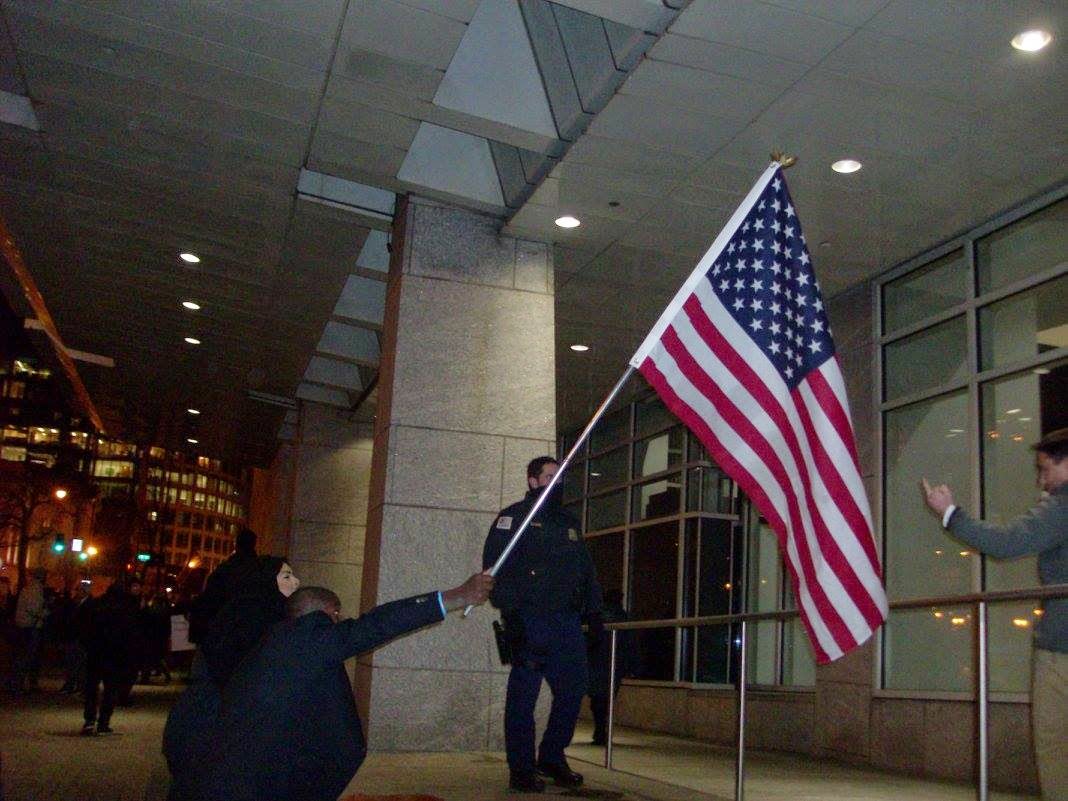 |
| Zionist "salutes" Old Glory |
 |
| Zionists appropriating the American flag with their Israel first agenda |
 |
| Zionists fly IDF flag. |
 |
| A Zionist group from our neck of the woods |
 |
| Real 1%ers know better than to support Israel, unlike this weekend warrior. |

 |
| Heavy police presence surrounding Neturei Karta |


 |
| NATA stands with Neturei Karta |
 |
| No police presence surrounding Zionists |
 |
| The great Patriot John Wilkes Booth |
 |
| Sic Semper Tyrannis |
 |
| Red Terror |
 |
| NATA at FBI |

Thursday, September 25, 2014
Open Source Law
By: Pasquale Pulella
NATA-NY

So instead of using violent force to break the will of someone you want to control, we can have agreements based on voluntary associations of individuals or collectives. Violence is to be used only when necessary. This system of laws may be seen as a guideline for the autonomous order of a free society. The concept of open source law is not unique to post-Proudhon anarchists. Pirates of the 1600’s even had their own set of laws they called the pirate code, Early Ireland had Brehon law, 16th century Italy had the code of Omerta` (I’ll write another article about this). Ethics can also be seen by some as open source law, applied correctly Ethics can mirror natural law exactly. Natural law demands that you do what you want so long as it does not directly harm your fellow man. The Non-Aggression principle is an example of natural law/ethics. People can regulate themselves in dangerous behavior biased on proper education. An example would be that a boy scout is taught to put out campfires when they leave, no law can actually stop anyone from doing otherwise.
Anarchistic law would probably be applied in a similar manner to the following. This is not an anarchist constitution but rather a guideline for one. If anyone has revisions they wish to make I would highly recommend you formulate it in another article entitled “Open Source Law Redo by_____”
The initiation of violence is prohibited unless with the consent or agreement between the offender and victim.
a. If two people get into a fight it does not matter who hit first it is a dispute witch both parties must resolve unless either side calls for a third party to keep the piece or resolve a dispute (lawyer/arbitrator/professional juror [like in Celtic Ireland]/peacekeeping militia, etc.)
b. The use of defensive violence is not prohibited no matter what kind of violence is used. If someone uses excessive violence in defense it does not constitute a crime. (If someone tries to rob someone with a pocketknife then the person getting robed has the right to kill them with a bazooka.)
c. No regulation may be implemented based on violence or the threat of violence unless it protects the free will of a group or individual or their possessions ownership/use. Also it may be used to maintain collective or individual separatism.
2. When using possessions that do not belong to said user they must consent to certain criteria implemented by the possessor.
a. If using an individual’s possession, the possessor may require that the user consent to certain criteria for the protection of or to obtain or restrain certain benefits of said possession.
b. If an individual or collective uses the possession of a collective the possessors may require that the user(s) consent to certain criteria for the purpose of protection of the possession or for certain benefits it may or may not give.
3. Possession may be obtained and/or lost.
a. Possession may be obtained when an individual or collective apply their labor to a non-possessed object, land, or animal. (Does not apply when other peoples uses of said possession does not restrict that of the original possessor.
b. Possession may be lost when said possession is neglected or when the possessor dies or permanently vacates to another location where the possession is not present.
4. Law practice in a free society must abide by the Non-Aggression Principle.
a. Both parties may agree on what law consultant to consult and act as a third party to a dispute
b. If the two parties do not agree on what law arbitrator to consult each person(s) may consult their own and both acting lawyers must put together a jury of the defendant’s community (people who know him/her somewhat)
c. All parties involved in a dispute can come to agreement on the defendant’s innocence or guilt based off of proof of crime and both parties may agree to reparations.
d. If the guilty defendant cannot pay for reparations with his personal resources than the defendant may pay with his labor in a reasonable manor agreed upon by both parties.
e. If a defendant does not agree to pay reparations or to show up for his dispute/trial he is a violator of the Non-Aggression Principle and the use of violence is neither necessary nor prohibited against the violator.
5. The right to be governed. All people have a right to be free but alternatively they also have a right to be enslaved, Should they want.
a. If a government is to be formed in a free society it must consist of a defined area where all the people consent to be governed by hierarchical violence
b. If a government is formed and the people rebel the law of nature will not protect the government that is formed nor will it protect any beneficiary’s and should they use violence against the government and flee to free land no law system can condemn them
Definitions
Ø Possession; objects, lands, animals that are used, maintained, operated, and/or acquired by a group or individual for their own use, and they maintain the rights to its usage.
Ø Separatism; Independence or voluntary non-association with an individual or groups of individuals. Certain people may be restricted access to certain private lands or possessions
Ø Non-Aggression Principle; the principle by witch no person may initiate violence, the threat of violence, physical force, or fraud against another person unless such a person has violated the principle on them.
Wednesday, September 17, 2014
What Scottish Independence Means for Anarchism
by Daniel Hawkins
VIA:The Art of Not being Governed
Something earth-shattering is about to happen.
Tomorrow, the British-ruled country known as Scotland will vote for their independence.
The news has been focusing almost entirely on what this will mean for the UK and Europe. Most people have been completely preoccupied with what this will mean for the area economically. But that isn’t half the story; the trivialization of the matter should not be surprising. In all likelihood, if you’re an American reader, you probably hadn’t even heard of the Scottish independence referendum until the last week or two. But don’t be fooled; this is a momentous and historic event. This vote has the power to change the world forever. This may seem like a long-winded article, but I beg you to stay with it, and watch for the results of what may be the most important vote in history.
To understand why this is so important for you and why this could potentially transform the world as we know it, we have to learn the story behind it. To know why many Scots want to separate from England and the UK, we must first understand why these two countries are so different; we have to understand the history and nature of Great Britain.
First, some lessons in terminology are in order. If this seems elementary to you, I apologize, but most of us Americans are kept in ignorance by our media and schools, so this is important. The British Isles consist of: Ireland, Scotland, England,* the Isle of Man, Ireland, and many surrounding islands. The British government rules over all of the British Isles except for the Republic of Ireland. What we call Great Britain consists of one island divided into three countries: England, Wales, and Scotland. This is the British mainland, stretching from Dover in the south to the Orkneys in the north. The United Kingdom, however, is a little different. The UK consists of: Great Britain (i.e., England, Scotland, and Wales), as well as the Isle of Man, Northern Ireland, and several other islands. While the Union Jack does not contain the Welsh flag, it basically integrates the countries of the UK into it:

This is their story:
2,400 years ago, war and agricultural pressures forced the Celts to leave their homelands (modern-day France, Spain, and other parts of the European mainland). Sailing north, the Celts peopled the British Isles. From the Stone Age to the Iron Age, they dominated the area.** The marks of their rich and ancient history can be seen all over the Isles, from the Ring of Brodgar to Stonehenge, from the Meath Stone of Destiny to Castell Henllys.
Slowly, the Celts formed their own distinct sub-cultures and societies. The inhabitants of the large island to the west became known as the Irish. On the mainland known today as Great Britain, the Britons occupied the south. To the north lived the Picts, or the Scots as they were also called. The wild land on the west coast belonged to the Welsh. Over the centuries—due to some amount of luck and bloody struggle—remnants of these Celtic cultures have managed to survive in many parts of the British Isles.
Both the Romans and Greeks attempted to colonize the Isles, but to little avail. Upon hearing of its tempestuous sea and its wild people, the Romans were too afraid to enter Ireland. They tried and failed to tame the Welsh, and were repeated repelled by the fearsome Scots/Picts to the north. It seemed their domain would have to remain in the south. After much frustration, the Roman emperor Hadrian built a 73 mile-long stone wall between present-day Scotland and present-day England. For centuries, Hadrian’s Wall was considered the border between the wilder north and the more civilized south. This was only the beginning of the divide.
The Britons and the Romans lived together, sometimes in peace and other times in war. The Romans totally changed the cultural landscape, influencing everything on the British mainland, from law to art to religion, but the Britons still held fast to their heritage. Most historians consider their legacy to be the civilizing of the Britons. Ultimately, though, the land proved to be too distant and too wild compared to their homelands for the Greeks or the Romans to govern. As the Roman and Greek presence in Britain dwindled, another invasion began.
Driven by their own conflicts and agricultural pressures, three tribes from modern-day Germany sailed across the sea and into the British Isles. In the northernmost area of Germany, along the Danish border, came the Jutes. Just south of them came the Angles. From further south still came the most dominant tribe, the Saxons. Cousins to the Vikings who came later, these tribes brought with them a new religion, a new writing system, and a new language. They never quite made a strong impact in Ireland, Scotland, Cornwall, or Wales, however. Like the Greeks and Romans before them, these Germanic tribes were mostly restricted to the south. The Celtic lands proved again unconquerable.
Eventually, these three Germanic tribes became known as the Anglo-Saxons. Their new domain was called Angle-Land, or as we call it today, England. The Anglo-Saxon influence cannot be overstated. The English language owes its existence to the Anglo-Saxons (going back to the writing of Beowulf). We even borrow our days of the week from their religion: for example, Woden (their cognate of Odin) lends his name to Wednesday. As Christianity spread through Europe, it is believed by scholars that some Britons were Christianized earlier than the Anglo-Saxons, but that the Anglo-Saxons played a crucial role in establishing Catholicism as the first official religion of England.
By the 9th century AD, (after about 250 years of rule) not only was their culture unrecognizable, but the style of government in England was completely different than the Celtic lands outside it. While the Celts probably clung to polycentric law and clan chieftains, the Anglo-Saxons created a mix of Germanic and Roman governing systems. What came out was a patchwork of earldoms, with written laws and legal monopolies. While language and religion easily crossed borders, the legal culture struggled to. These differences divided the Celts from the English, and enmity grew between them at every opportunity.
The Viking invasion had a considerable effect on life in the British Isles. These pagan pillagers had little mercy for what was, to them, a fertile land ripe for harvest. Unlike the Romans, they battled the Irish Celts for as long as they could. The threat to the English way of life was so great that the Anglo-Saxon earls united under a high king, establishing, for the very first time, the English Monarchy.***
The Vikings remained there for about 150 years, building permanent settlements in Ireland, Scotland, and most notably, eastern England. The area of England ruled by the Vikings became known as Danelaw. The remaining English lands—Wessex and part of Mercia—could be considered more civilized, but life was not easy for them. The English and Vikings were nearly constantly at war. Some Celts allied themselves with the Vikings in order to push the Anglo-Saxons out of their lands, but ultimately failed. The new English Monarchy claimed control of Wales and Cornwall, forming Britannia.
Danelaw finally fell—partly through war and partly through political alliances—toward the end of the Anglo-Saxon reign. The mark of the Vikings was left, but a new age was about to begin. After the death of King Edward the Confessor, several English earls vied for his throne. As England was weakened, a Norman nobleman by the name of William laid claim. The Normans, including Duke William, were descendants of Viking invaders, but were well integrated into French culture. With imperial ambitions and a name to make, William was about to change the face of the Britain forever.

In 1066, following political scandals involving the Anglo-Saxon earls, William invaded in full force. The Anglo-Saxons fell, and their kingdom fell with it. What followed was a revolution in law and culture. But, we must know, it came at a terrible price. It was not enough for William the Conqueror to subjugate western England. He conquered what remained of Danelaw, as well as the earldoms surrounding Hadrian’s Wall. This was the Harrowing of the North. With a method of Total War, William starved, smoked, and rooted out the English and Celts wherever he could. Moving further north, his invasion of Scotland proved to be a bloody campaign, culminating in the temporary defeat of the Scottish monarchy and clans.
William’s attempts to quell the Welsh and the Irish did not prove as successful as his English campaign. However, even after his death, his imperial legacy carried on. Eventually, alliances were made and broken, and the Normans brought their hammer down on these Celtic lands. But the United Kingdom was yet to be born. There remained strong pockets of Celtic resistance in Scotland, Wales, and Ireland, and their respective monarchs and chieftains put up a fight for another few centuries. Future monarchs like Queen Elizabeth I would follow in William’s footsteps, laying claim to the whole of the British Isles.
In William’s time, however, he exercised iron-fisted control over what lands he could govern. Building upon the heavily Romanized legal system in England, he ordered a massive census to be taken of everyone in his kingdom. This tome became known as the Domesday Book. The event was such a defeat for the free peoples, our word “doom” (and Doomsday) as well as our connotation of “reckoning” come from this act. As a uniform tax code was imposed on his kingdom, William centralized the government in a way that hadn’t been seen since the Roman occupation. As monarch of Britain, William paved the way for even more bad blood between the English and the Celts.
William the Conqueror not only centralized and formalized the law, but also helped to establish the Feudal system. While Feudalism existed in one form or another in the rest of the British Isles, it took a particularly strong hold in England in the form of Manoralism (essentially an aristocratic plantation system). This system was far more codified than any semi-Feudal system in the past or in the Celtic lands. The various dukes, earls, and barons of England often held some influence in the king’s court.
To be an English feudal lord, however, it was usually a prerequisite that one had to have Norman ancestry, since the Normans were the conquering force. This class of British citizenry became known as Anglo-Normans. Beneath them were the un-assimilated Celts and Anglo-Saxons, who often toiled in the fields and were conscripted into wars in the name of their feudal lords. In many cases, the Scots were literally enslaved by the English. This was the Medieval Age in Britain. With its own parliament, court, and monarchy, that special mix of Brittonic, Roman, Anglo-Saxon, Viking, and Norman cultures became what we know today as England.
Scotland, among the other Celtic lands, grew up with its own history. With very little Roman influence, very little Anglo-Saxon influence, some Viking influence, and some Norman influence, the Celtic culture of Scotland remained quite dominant for centuries. While it isn’t as prominent as in Ireland or Wales, Scotch Gaelic is still spoken by 1.1% of the Scottish population. Throughout the Middle Ages and Early Modern Era, Scotland and England had a “love-hate relationship,” to say the least. Different Houses of Scotland had different attitudes toward the English nobility and monarchy. Sometimes, a Scottish monarch would simultaneously be the English monarch, and vice versa. Sometimes, they would be separate. The history is complicated, to say the least. In any case, the Scots were never quite comfortable.
To say that the Scots were subject to foreign rule is both correct and incorrect, depending on whom you ask. The Unionist idea is generally that both countries exist on the same island, and the various intermarriages between the royal families forged a de facto relationship that served as the basis for the formal union. But there has never been any consensus on this issue in Scotland. Repeatedly, English monarchs attempted to truly conquer Scotland, but largely failed. In the periods of English rule, bloody rebellions were always sure to come. One of the most notable early wars came in the form of the First War of Scottish Independence, pitting King Robert the Bruce and William Wallace against King Edward (“Hammer of the Scots”) I. If you’ve seen Braveheart, you should be a little familiar with this war. A period of independence followed****, but only for 18 years. Then followed the Second War of Independence, which lasted for about 25 years. Several rebellions were fought in the following centuries. As the English Reformation commenced, Scotland held onto Catholicism and also adopted Presbyterianism. This religious divide represented, and still represents, a massive divide between the cultures of the two nations. A true union between the two nations seemed impossible.

A union did come, however. When Scottish monarchs held sway in England—particularly the Stuarts—the idea of a union was supported by most of the Scots. In 1603, the Scottish monarch James VI (James I in England) became the first monarch of Great Britain. This drove a wedge into Scotland between those who were satisfied with British rule (as long as it meant having a Scottish monarch to represent their interests), and those who believed that a union, no matter who was in charge, would be ultimately controlled by aristocrats. The divide remains there today.
For 100 years, the debate raged on, as did the English Civil War. However, the general idea (at least as phrased by the Unionists) was that it would be a Union of the Crowns. For the duration of the 17th century, both countries had separate parliaments. Both nations had their disputes with their respective governments, but they were, in fact, distinct. Eventually, the Scottish Stuart line was deposed forever. Still, many Scots believed having a Scottish parliament would act as a bulwark against disconnected, English interests (sound familiar?). But as the 18th century dawned, things changed.
On May 1, 1707, the Union of the Kingdom of Great Britain was formed. If you ask a Unionist, they will tell you that the Scottish parliament and English parliament unified into one parliament—the Parliament of Great Britain, centered in Westminster—consisting of both Scottish and English members to represent regional interests. If you ask a Scottish Nationalist, however, they will tell you that Scotland was utterly robbed of its sovereignty. The Scottish parliament did vote in favor of a Union, but as we libertarians know, it’s hard saying whether or not a parliament truly represents the wishes of its people. In either case, Scottish representation and sovereignty was formally handed over to England for the first and final time.
In the 1740s, a huge group of rebellious Scots—known as the Jacobites—attempted to throw off English rule. This was one of the most significant Scottish Nationalist movements in history. Again, depending on whom you ask, their goals were either: to install a Stuart to the throne of the Union, or to install a Stuart to the Scottish throne and dissolve the Union. After a close fight, the Battle of Culloden signaled the defeat of the Jacobites. The English monarch (in this case the Anglo-German George II) would remain the monarch of Great Britain and the United Kingdom. The defeat was meant to be eternal. The Highland Clearances followed, sometimes with legal blows like the Highland Dress Act and the Disarming Act.

The 19th century was one of relatively absolute English rule. Expanding across the globe, the British Empire now had more than enough power to rule over most of its colonies. With Scotland as its neighbor, this proved to be relatively easy. A few skirmishes broke out here and there, but the Scots mostly deferred to the political process when they attempted to gain more independence. As the 20th century began, echoes of chaos came from the west.
The Irish War of Independence rocked the British Isles. The issue of Irish independence tore permanent rifts within the British and Irish citizenry. Ireland, much like Scotland, was once a Celtic nation, and had developed a completely different ethnic, religious, and cultural heritage from England. Their own wars of independence were fought, and their sovereignty was never taken quite as seriously as Scotland’s by the British government. From 1918 into the ‘20s, the gravity of the Irish desire to break from England was felt by nearly everyone. This history warrants its own article, if not series of books, but to keep it brief: The northern Irish province of Ulster had long been inhabited by both an Irish Catholic underclass and Anglo-Irish Protestant “planters.” The Planters exercised much political and economic control over the area, extending down into Ireland.

Because so many people of British ancestry lived in Ulster, when the Anglo-Irish Treaty was finally signed in 1921, Ulster—which from then on was called Northern Ireland—opted out of the newly-formed Irish Free State in favor of joining the UK. The Irish Republican Army (IRA), which had fought for independence, was fragmented into two main groups: those who supported Northern Ireland’s loyalty to Britain, and those who wanted a united Ireland. Fueled by religious and political differences, the two sides formed their own paramilitary organizations and political parties. Violence over this issue lasted throughout the 20th century and into today. It was not contained to Northern Ireland, however, but spread across the water into Great Britain and the United States. While the violence has subsided, the divide remains.
The issue of Irish independence and the violent tenacity of the IRA lit a fire beneath the British government. With a large Catholic populace, many Scots were sympathetic to the Irish cause from the start. Others still (mostly Unionists) supported the Loyalist cause. Scots, for most of the 20th century, were not only preoccupied with being drafted into both World Wars, but generally were disinterested in armed resistance. Like Ulster, Scotland remained (and remains) divided on Unionism. Violence, for the most part, has been out of the question. With the formation of the Scottish National Party (the SNP) in the early half of the 20th century, Scotland gained significant political influence in Westminster. By the 1990s, Scotland regained its own parliament. Most people term this phenomenon “devolution” (you be the judge about what connotation that brings).
As Britain lost its colonies overseas, hopes for Scottish separatism grew. In the 1970s, upon discovering oil in the North Sea (in Scottish waters), many Scots—particularly Nationalists—supported the idea that the revenue from the oil should flow into Scotland. British Petroleum (BP), formerly the Anglo-Iranian Oil Company, immediately focused on obtaining North Sea oil. Norway obtained much of the oil, but many Scots viewed the oil as belonging not to Britain as a whole, but to Scotland. With billions of barrels of oil at stake, it’s no wonder that BP is urging Scotland to stay in the Union. The financial concerns of England (well, more accurately, English Corporatists) are taking center-stage. The English aristocrats and bureaucrats are begging Scotland to stay in the Union. The attitude of many of those in the “Better Together” campaign can be called, at times, condescending. The shackles of empire are quaking under the strength of the Scottish spirit of liberty.

More importantly, the breaking up not only of the United Kingdom but of Great Britain itself means that large governments, maybe the State itself, could lose power at any moment. It’s no surprise to anyone that the idea of secession is gaining legitimacy around the world. Kurdish secession, Ukrainian/Russian secession, Venetian secession, Texan secession, the successful South Sudanese secession—even the corporatist propaganda outlets are taking notice. The question posed by these movements is: “If Scotland can successfully break away after 1,000 years of attempted and successful English rule, why can’t we?”
That’s the question of the century. That’s what it all comes down to. One of the many definitions of “nation” (and the one I favor) is: “an aggregation of persons of the same ethnic family, often speaking the same language or cognate languages.” (http://dictionary.reference.com/browse/nation).By this definition, and by the measure of History, these are two separate nations. Here’s a more important point:
Any human being—regardless of origin, regardless of reason, regardless of political position—deserves to be free. They deserve to make their own destiny. Many conservatives, libertarians, and even some anarchists have been criticizing Scottish independence as silly. Their new government, and the SNP in general, may turn Scotland in to a socialist nation in the style of Sweden or Denmark. This is true. Most Scottish Nationalists lean fairly hard to the Left. But that doesn’t always have to be the case. Who knows what will happen to Scotland in the future. Even if it is the case, why does it matter? It’s not my country. They are their own people, each individual Scot is his or her own person. It’s not my place nor is it my desire to tell them what to do.
Whether or not Scotland can be economically viable is a matter of debate, but everyone should note that the same country that churned out world-renowned shakers like Adam Smith and James Watt has a historical foundation to stand on when it comes to economics. Many Scots want to be free. They’re tired of the English yoke. They’re tired of being subjects of the Queen and Prime Minister. They’re tired of getting pushed into Britain and America’s costly wars, and tired of sacrificing their freedom in the process. They want to trade with who they choose to trade with. They want to break away and form their own destiny. As Lysander Spooner said about the American Civil War:
“The question of treason is distinct from that of slavery; and is the same that it would have been, if free States, instead of slave States, had seceded. On the part of the North, the war was carried on, not to liberate the slaves, but by a government that had always perverted and violated the Constitution, to keep the slaves in bondage; and was still willing to do so, if the slaveholders could thereby induced to stay in the Union. The principle, on which the war was waged by the North, was simply this: That men may rightfully be compelled to submit to, and support, a government that they do not want; and that resistance, on their part, makes them traitors and criminals.”
Secession is a dangerous idea. The failure of secession movements or any rebellion can inspire two things: a renewed faith in large, imperial governments, or a loss of faith in government in general. In my opinion as an anarchist, I am not always disheartened when revolutions fail. The political process, after all, is fundamentally opposed to liberty. If secession movements win, the results are obvious. If this referendum passes, it could mean that the concept of empire, that the concept of government, is in its death throes. As the “libertarian moment” approaches, this could mean the dawning of an era of real, honest freedom. Yes, secession could mean that Scotland could fall under another corrupt government, and yes, I believe that all government is slavery. I’m not a Minarchist. The key difference here, and the reason why I as an anarchist support this movement, is because this is a step toward the right direction. I don’t want the Scots to stop at national independence. I want them only to pass through and go on to better things. I don’t want Scottish Nationalism; I want Scottish Separatism. I want real independence for each and every Scot, for each and every human.

“Once one concedes that a single world government is not necessary, then where does one logically stop at the permissibility of separate states? If Canada and the United States can be separate nations without being denounced as in a state of impermissible ‘anarchy’, why may not the South secede from the United States? New York State from the Union? New York City from the state? Why may not Manhattan secede? Each neighbourhood? Each block? Each house? Each person?”
–Murray Rothbard
*Whether Cornwall should be considered part of England is its own issue. A heavily Celtic area, Cornwall has its own unique history and culture, along with a thriving independence movement of its own.
**A large portion of historians term this area of Europe “Gaul” (the name the Romans gave it), and so term the Celts who moved away “Gaels.” We call their language/culture Gaelic. There are subtleties and debates about this terminology, however.
***It was around this time that Scotland came under a monarch. However, it remained a Scottish monarch for centuries, and most monarchs had considerably weaker control over the clans when compared with the English system of governance. Even after the Norman invasion, Scotland (due to its distance and its distinct culture) was difficult to pull under their yoke.
****While Edward ultimately failed to unite the kingdoms under his rule, he did succeed in taking the Stone of Scone as a spoil of war. The Stone of Scone (also called the Stone of Destiny) was symbolically used as the coronation rock for the high kings of Scotland, and remains an important cultural icon. The Stone was placed under the Coronation Chair in Westminster Abbey, where it remained for centuries. In 1950, some Scottish Nationalist students attempted to steal the Stone and return it to Scotland; however, the British police returned it. In the 1990s, in a symbol of amicable union and apology for past offences, the stone was returned to Edinburgh.
VIA:The Art of Not being Governed
Something earth-shattering is about to happen.
Tomorrow, the British-ruled country known as Scotland will vote for their independence.
The news has been focusing almost entirely on what this will mean for the UK and Europe. Most people have been completely preoccupied with what this will mean for the area economically. But that isn’t half the story; the trivialization of the matter should not be surprising. In all likelihood, if you’re an American reader, you probably hadn’t even heard of the Scottish independence referendum until the last week or two. But don’t be fooled; this is a momentous and historic event. This vote has the power to change the world forever. This may seem like a long-winded article, but I beg you to stay with it, and watch for the results of what may be the most important vote in history.
To understand why this is so important for you and why this could potentially transform the world as we know it, we have to learn the story behind it. To know why many Scots want to separate from England and the UK, we must first understand why these two countries are so different; we have to understand the history and nature of Great Britain.
First, some lessons in terminology are in order. If this seems elementary to you, I apologize, but most of us Americans are kept in ignorance by our media and schools, so this is important. The British Isles consist of: Ireland, Scotland, England,* the Isle of Man, Ireland, and many surrounding islands. The British government rules over all of the British Isles except for the Republic of Ireland. What we call Great Britain consists of one island divided into three countries: England, Wales, and Scotland. This is the British mainland, stretching from Dover in the south to the Orkneys in the north. The United Kingdom, however, is a little different. The UK consists of: Great Britain (i.e., England, Scotland, and Wales), as well as the Isle of Man, Northern Ireland, and several other islands. While the Union Jack does not contain the Welsh flag, it basically integrates the countries of the UK into it:

This is their story:
2,400 years ago, war and agricultural pressures forced the Celts to leave their homelands (modern-day France, Spain, and other parts of the European mainland). Sailing north, the Celts peopled the British Isles. From the Stone Age to the Iron Age, they dominated the area.** The marks of their rich and ancient history can be seen all over the Isles, from the Ring of Brodgar to Stonehenge, from the Meath Stone of Destiny to Castell Henllys.
Slowly, the Celts formed their own distinct sub-cultures and societies. The inhabitants of the large island to the west became known as the Irish. On the mainland known today as Great Britain, the Britons occupied the south. To the north lived the Picts, or the Scots as they were also called. The wild land on the west coast belonged to the Welsh. Over the centuries—due to some amount of luck and bloody struggle—remnants of these Celtic cultures have managed to survive in many parts of the British Isles.
Both the Romans and Greeks attempted to colonize the Isles, but to little avail. Upon hearing of its tempestuous sea and its wild people, the Romans were too afraid to enter Ireland. They tried and failed to tame the Welsh, and were repeated repelled by the fearsome Scots/Picts to the north. It seemed their domain would have to remain in the south. After much frustration, the Roman emperor Hadrian built a 73 mile-long stone wall between present-day Scotland and present-day England. For centuries, Hadrian’s Wall was considered the border between the wilder north and the more civilized south. This was only the beginning of the divide.
The Britons and the Romans lived together, sometimes in peace and other times in war. The Romans totally changed the cultural landscape, influencing everything on the British mainland, from law to art to religion, but the Britons still held fast to their heritage. Most historians consider their legacy to be the civilizing of the Britons. Ultimately, though, the land proved to be too distant and too wild compared to their homelands for the Greeks or the Romans to govern. As the Roman and Greek presence in Britain dwindled, another invasion began.
Driven by their own conflicts and agricultural pressures, three tribes from modern-day Germany sailed across the sea and into the British Isles. In the northernmost area of Germany, along the Danish border, came the Jutes. Just south of them came the Angles. From further south still came the most dominant tribe, the Saxons. Cousins to the Vikings who came later, these tribes brought with them a new religion, a new writing system, and a new language. They never quite made a strong impact in Ireland, Scotland, Cornwall, or Wales, however. Like the Greeks and Romans before them, these Germanic tribes were mostly restricted to the south. The Celtic lands proved again unconquerable.
Eventually, these three Germanic tribes became known as the Anglo-Saxons. Their new domain was called Angle-Land, or as we call it today, England. The Anglo-Saxon influence cannot be overstated. The English language owes its existence to the Anglo-Saxons (going back to the writing of Beowulf). We even borrow our days of the week from their religion: for example, Woden (their cognate of Odin) lends his name to Wednesday. As Christianity spread through Europe, it is believed by scholars that some Britons were Christianized earlier than the Anglo-Saxons, but that the Anglo-Saxons played a crucial role in establishing Catholicism as the first official religion of England.
By the 9th century AD, (after about 250 years of rule) not only was their culture unrecognizable, but the style of government in England was completely different than the Celtic lands outside it. While the Celts probably clung to polycentric law and clan chieftains, the Anglo-Saxons created a mix of Germanic and Roman governing systems. What came out was a patchwork of earldoms, with written laws and legal monopolies. While language and religion easily crossed borders, the legal culture struggled to. These differences divided the Celts from the English, and enmity grew between them at every opportunity.
The Viking invasion had a considerable effect on life in the British Isles. These pagan pillagers had little mercy for what was, to them, a fertile land ripe for harvest. Unlike the Romans, they battled the Irish Celts for as long as they could. The threat to the English way of life was so great that the Anglo-Saxon earls united under a high king, establishing, for the very first time, the English Monarchy.***
The Vikings remained there for about 150 years, building permanent settlements in Ireland, Scotland, and most notably, eastern England. The area of England ruled by the Vikings became known as Danelaw. The remaining English lands—Wessex and part of Mercia—could be considered more civilized, but life was not easy for them. The English and Vikings were nearly constantly at war. Some Celts allied themselves with the Vikings in order to push the Anglo-Saxons out of their lands, but ultimately failed. The new English Monarchy claimed control of Wales and Cornwall, forming Britannia.
Danelaw finally fell—partly through war and partly through political alliances—toward the end of the Anglo-Saxon reign. The mark of the Vikings was left, but a new age was about to begin. After the death of King Edward the Confessor, several English earls vied for his throne. As England was weakened, a Norman nobleman by the name of William laid claim. The Normans, including Duke William, were descendants of Viking invaders, but were well integrated into French culture. With imperial ambitions and a name to make, William was about to change the face of the Britain forever.

William the Conqueror, Duke of Normandy and King of Great Britain
In 1066, following political scandals involving the Anglo-Saxon earls, William invaded in full force. The Anglo-Saxons fell, and their kingdom fell with it. What followed was a revolution in law and culture. But, we must know, it came at a terrible price. It was not enough for William the Conqueror to subjugate western England. He conquered what remained of Danelaw, as well as the earldoms surrounding Hadrian’s Wall. This was the Harrowing of the North. With a method of Total War, William starved, smoked, and rooted out the English and Celts wherever he could. Moving further north, his invasion of Scotland proved to be a bloody campaign, culminating in the temporary defeat of the Scottish monarchy and clans.
William’s attempts to quell the Welsh and the Irish did not prove as successful as his English campaign. However, even after his death, his imperial legacy carried on. Eventually, alliances were made and broken, and the Normans brought their hammer down on these Celtic lands. But the United Kingdom was yet to be born. There remained strong pockets of Celtic resistance in Scotland, Wales, and Ireland, and their respective monarchs and chieftains put up a fight for another few centuries. Future monarchs like Queen Elizabeth I would follow in William’s footsteps, laying claim to the whole of the British Isles.
In William’s time, however, he exercised iron-fisted control over what lands he could govern. Building upon the heavily Romanized legal system in England, he ordered a massive census to be taken of everyone in his kingdom. This tome became known as the Domesday Book. The event was such a defeat for the free peoples, our word “doom” (and Doomsday) as well as our connotation of “reckoning” come from this act. As a uniform tax code was imposed on his kingdom, William centralized the government in a way that hadn’t been seen since the Roman occupation. As monarch of Britain, William paved the way for even more bad blood between the English and the Celts.
William the Conqueror not only centralized and formalized the law, but also helped to establish the Feudal system. While Feudalism existed in one form or another in the rest of the British Isles, it took a particularly strong hold in England in the form of Manoralism (essentially an aristocratic plantation system). This system was far more codified than any semi-Feudal system in the past or in the Celtic lands. The various dukes, earls, and barons of England often held some influence in the king’s court.
To be an English feudal lord, however, it was usually a prerequisite that one had to have Norman ancestry, since the Normans were the conquering force. This class of British citizenry became known as Anglo-Normans. Beneath them were the un-assimilated Celts and Anglo-Saxons, who often toiled in the fields and were conscripted into wars in the name of their feudal lords. In many cases, the Scots were literally enslaved by the English. This was the Medieval Age in Britain. With its own parliament, court, and monarchy, that special mix of Brittonic, Roman, Anglo-Saxon, Viking, and Norman cultures became what we know today as England.
Scotland, among the other Celtic lands, grew up with its own history. With very little Roman influence, very little Anglo-Saxon influence, some Viking influence, and some Norman influence, the Celtic culture of Scotland remained quite dominant for centuries. While it isn’t as prominent as in Ireland or Wales, Scotch Gaelic is still spoken by 1.1% of the Scottish population. Throughout the Middle Ages and Early Modern Era, Scotland and England had a “love-hate relationship,” to say the least. Different Houses of Scotland had different attitudes toward the English nobility and monarchy. Sometimes, a Scottish monarch would simultaneously be the English monarch, and vice versa. Sometimes, they would be separate. The history is complicated, to say the least. In any case, the Scots were never quite comfortable.
To say that the Scots were subject to foreign rule is both correct and incorrect, depending on whom you ask. The Unionist idea is generally that both countries exist on the same island, and the various intermarriages between the royal families forged a de facto relationship that served as the basis for the formal union. But there has never been any consensus on this issue in Scotland. Repeatedly, English monarchs attempted to truly conquer Scotland, but largely failed. In the periods of English rule, bloody rebellions were always sure to come. One of the most notable early wars came in the form of the First War of Scottish Independence, pitting King Robert the Bruce and William Wallace against King Edward (“Hammer of the Scots”) I. If you’ve seen Braveheart, you should be a little familiar with this war. A period of independence followed****, but only for 18 years. Then followed the Second War of Independence, which lasted for about 25 years. Several rebellions were fought in the following centuries. As the English Reformation commenced, Scotland held onto Catholicism and also adopted Presbyterianism. This religious divide represented, and still represents, a massive divide between the cultures of the two nations. A true union between the two nations seemed impossible.

Robert the Bruce, King of Scotland. William Wallace and Robert the Bruce remain enormously important figures in Scotland.
A union did come, however. When Scottish monarchs held sway in England—particularly the Stuarts—the idea of a union was supported by most of the Scots. In 1603, the Scottish monarch James VI (James I in England) became the first monarch of Great Britain. This drove a wedge into Scotland between those who were satisfied with British rule (as long as it meant having a Scottish monarch to represent their interests), and those who believed that a union, no matter who was in charge, would be ultimately controlled by aristocrats. The divide remains there today.
For 100 years, the debate raged on, as did the English Civil War. However, the general idea (at least as phrased by the Unionists) was that it would be a Union of the Crowns. For the duration of the 17th century, both countries had separate parliaments. Both nations had their disputes with their respective governments, but they were, in fact, distinct. Eventually, the Scottish Stuart line was deposed forever. Still, many Scots believed having a Scottish parliament would act as a bulwark against disconnected, English interests (sound familiar?). But as the 18th century dawned, things changed.
On May 1, 1707, the Union of the Kingdom of Great Britain was formed. If you ask a Unionist, they will tell you that the Scottish parliament and English parliament unified into one parliament—the Parliament of Great Britain, centered in Westminster—consisting of both Scottish and English members to represent regional interests. If you ask a Scottish Nationalist, however, they will tell you that Scotland was utterly robbed of its sovereignty. The Scottish parliament did vote in favor of a Union, but as we libertarians know, it’s hard saying whether or not a parliament truly represents the wishes of its people. In either case, Scottish representation and sovereignty was formally handed over to England for the first and final time.
In the 1740s, a huge group of rebellious Scots—known as the Jacobites—attempted to throw off English rule. This was one of the most significant Scottish Nationalist movements in history. Again, depending on whom you ask, their goals were either: to install a Stuart to the throne of the Union, or to install a Stuart to the Scottish throne and dissolve the Union. After a close fight, the Battle of Culloden signaled the defeat of the Jacobites. The English monarch (in this case the Anglo-German George II) would remain the monarch of Great Britain and the United Kingdom. The defeat was meant to be eternal. The Highland Clearances followed, sometimes with legal blows like the Highland Dress Act and the Disarming Act.

The bloody Battle of Culloden ushered in and solidified an era of Scotland’s ethno-cultural cleansing.
The 19th century was one of relatively absolute English rule. Expanding across the globe, the British Empire now had more than enough power to rule over most of its colonies. With Scotland as its neighbor, this proved to be relatively easy. A few skirmishes broke out here and there, but the Scots mostly deferred to the political process when they attempted to gain more independence. As the 20th century began, echoes of chaos came from the west.
The Irish War of Independence rocked the British Isles. The issue of Irish independence tore permanent rifts within the British and Irish citizenry. Ireland, much like Scotland, was once a Celtic nation, and had developed a completely different ethnic, religious, and cultural heritage from England. Their own wars of independence were fought, and their sovereignty was never taken quite as seriously as Scotland’s by the British government. From 1918 into the ‘20s, the gravity of the Irish desire to break from England was felt by nearly everyone. This history warrants its own article, if not series of books, but to keep it brief: The northern Irish province of Ulster had long been inhabited by both an Irish Catholic underclass and Anglo-Irish Protestant “planters.” The Planters exercised much political and economic control over the area, extending down into Ireland.

Michael Collins, Irish politician and first leader of the IRA. He was ultimately assassinated.
Because so many people of British ancestry lived in Ulster, when the Anglo-Irish Treaty was finally signed in 1921, Ulster—which from then on was called Northern Ireland—opted out of the newly-formed Irish Free State in favor of joining the UK. The Irish Republican Army (IRA), which had fought for independence, was fragmented into two main groups: those who supported Northern Ireland’s loyalty to Britain, and those who wanted a united Ireland. Fueled by religious and political differences, the two sides formed their own paramilitary organizations and political parties. Violence over this issue lasted throughout the 20th century and into today. It was not contained to Northern Ireland, however, but spread across the water into Great Britain and the United States. While the violence has subsided, the divide remains.
The issue of Irish independence and the violent tenacity of the IRA lit a fire beneath the British government. With a large Catholic populace, many Scots were sympathetic to the Irish cause from the start. Others still (mostly Unionists) supported the Loyalist cause. Scots, for most of the 20th century, were not only preoccupied with being drafted into both World Wars, but generally were disinterested in armed resistance. Like Ulster, Scotland remained (and remains) divided on Unionism. Violence, for the most part, has been out of the question. With the formation of the Scottish National Party (the SNP) in the early half of the 20th century, Scotland gained significant political influence in Westminster. By the 1990s, Scotland regained its own parliament. Most people term this phenomenon “devolution” (you be the judge about what connotation that brings).
As Britain lost its colonies overseas, hopes for Scottish separatism grew. In the 1970s, upon discovering oil in the North Sea (in Scottish waters), many Scots—particularly Nationalists—supported the idea that the revenue from the oil should flow into Scotland. British Petroleum (BP), formerly the Anglo-Iranian Oil Company, immediately focused on obtaining North Sea oil. Norway obtained much of the oil, but many Scots viewed the oil as belonging not to Britain as a whole, but to Scotland. With billions of barrels of oil at stake, it’s no wonder that BP is urging Scotland to stay in the Union. The financial concerns of England (well, more accurately, English Corporatists) are taking center-stage. The English aristocrats and bureaucrats are begging Scotland to stay in the Union. The attitude of many of those in the “Better Together” campaign can be called, at times, condescending. The shackles of empire are quaking under the strength of the Scottish spirit of liberty.

More importantly, the breaking up not only of the United Kingdom but of Great Britain itself means that large governments, maybe the State itself, could lose power at any moment. It’s no surprise to anyone that the idea of secession is gaining legitimacy around the world. Kurdish secession, Ukrainian/Russian secession, Venetian secession, Texan secession, the successful South Sudanese secession—even the corporatist propaganda outlets are taking notice. The question posed by these movements is: “If Scotland can successfully break away after 1,000 years of attempted and successful English rule, why can’t we?”
That’s the question of the century. That’s what it all comes down to. One of the many definitions of “nation” (and the one I favor) is: “an aggregation of persons of the same ethnic family, often speaking the same language or cognate languages.” (http://dictionary.reference.com/browse/nation).By this definition, and by the measure of History, these are two separate nations. Here’s a more important point:
Any human being—regardless of origin, regardless of reason, regardless of political position—deserves to be free. They deserve to make their own destiny. Many conservatives, libertarians, and even some anarchists have been criticizing Scottish independence as silly. Their new government, and the SNP in general, may turn Scotland in to a socialist nation in the style of Sweden or Denmark. This is true. Most Scottish Nationalists lean fairly hard to the Left. But that doesn’t always have to be the case. Who knows what will happen to Scotland in the future. Even if it is the case, why does it matter? It’s not my country. They are their own people, each individual Scot is his or her own person. It’s not my place nor is it my desire to tell them what to do.
Whether or not Scotland can be economically viable is a matter of debate, but everyone should note that the same country that churned out world-renowned shakers like Adam Smith and James Watt has a historical foundation to stand on when it comes to economics. Many Scots want to be free. They’re tired of the English yoke. They’re tired of being subjects of the Queen and Prime Minister. They’re tired of getting pushed into Britain and America’s costly wars, and tired of sacrificing their freedom in the process. They want to trade with who they choose to trade with. They want to break away and form their own destiny. As Lysander Spooner said about the American Civil War:
“The question of treason is distinct from that of slavery; and is the same that it would have been, if free States, instead of slave States, had seceded. On the part of the North, the war was carried on, not to liberate the slaves, but by a government that had always perverted and violated the Constitution, to keep the slaves in bondage; and was still willing to do so, if the slaveholders could thereby induced to stay in the Union. The principle, on which the war was waged by the North, was simply this: That men may rightfully be compelled to submit to, and support, a government that they do not want; and that resistance, on their part, makes them traitors and criminals.”
Secession is a dangerous idea. The failure of secession movements or any rebellion can inspire two things: a renewed faith in large, imperial governments, or a loss of faith in government in general. In my opinion as an anarchist, I am not always disheartened when revolutions fail. The political process, after all, is fundamentally opposed to liberty. If secession movements win, the results are obvious. If this referendum passes, it could mean that the concept of empire, that the concept of government, is in its death throes. As the “libertarian moment” approaches, this could mean the dawning of an era of real, honest freedom. Yes, secession could mean that Scotland could fall under another corrupt government, and yes, I believe that all government is slavery. I’m not a Minarchist. The key difference here, and the reason why I as an anarchist support this movement, is because this is a step toward the right direction. I don’t want the Scots to stop at national independence. I want them only to pass through and go on to better things. I don’t want Scottish Nationalism; I want Scottish Separatism. I want real independence for each and every Scot, for each and every human.

“Once one concedes that a single world government is not necessary, then where does one logically stop at the permissibility of separate states? If Canada and the United States can be separate nations without being denounced as in a state of impermissible ‘anarchy’, why may not the South secede from the United States? New York State from the Union? New York City from the state? Why may not Manhattan secede? Each neighbourhood? Each block? Each house? Each person?”
–Murray Rothbard
Soar Alba gu bràth
Footnotes:*Whether Cornwall should be considered part of England is its own issue. A heavily Celtic area, Cornwall has its own unique history and culture, along with a thriving independence movement of its own.
**A large portion of historians term this area of Europe “Gaul” (the name the Romans gave it), and so term the Celts who moved away “Gaels.” We call their language/culture Gaelic. There are subtleties and debates about this terminology, however.
***It was around this time that Scotland came under a monarch. However, it remained a Scottish monarch for centuries, and most monarchs had considerably weaker control over the clans when compared with the English system of governance. Even after the Norman invasion, Scotland (due to its distance and its distinct culture) was difficult to pull under their yoke.
****While Edward ultimately failed to unite the kingdoms under his rule, he did succeed in taking the Stone of Scone as a spoil of war. The Stone of Scone (also called the Stone of Destiny) was symbolically used as the coronation rock for the high kings of Scotland, and remains an important cultural icon. The Stone was placed under the Coronation Chair in Westminster Abbey, where it remained for centuries. In 1950, some Scottish Nationalist students attempted to steal the Stone and return it to Scotland; however, the British police returned it. In the 1990s, in a symbol of amicable union and apology for past offences, the stone was returned to Edinburgh.
Saturday, August 23, 2014
Proxy Violence: On Killing with "Clean" Hands
Via :The Enigma of Steel

From our Inception, We Have Been a Species at War. I strongly feel that the anarchist/ libertarian non-aggression principle to be rooted in utopian fantasy and to operate as an ideal, rather than a historical reality. (I fully expect written refutations to this in my mailbox.) It is not non-aggression that has fuelled most technological nor moral/ philosophical advancements that culminated in this “modern” age, but I'll save more in depth discussion of this for another day.
On many levels, there has been a centuries-long, collective drive - by academics, philosophers, and just ordinary men and women, to move away from this incessant infighting and toward a more Star Trek-style utopia – ultimately devoid of war and sickness – where humanity can work together to improve its existence on this blue-green marble we call Earth. The way Western Civilization has flourished, it has made perfect sense that many of the old ways would be left behind. Much of the world we see today barely resembles the more organically-tribalistic patchwork of nation-states that ruled and defined our ancestors for most of human evolution.
But violence has always been a necessary part of this succession. It is the constant and implicit structure which has guarded the perimeter, and watched over the darkest nights so that artists can draw, singers can sing, and workers can work without worrying about a face-painted savage (and I mean “savage” in the most complimentary and empowering way – savagery becomes a virtue when negotiations have failed and violence is the only option which remains,) driving a spear through their cervical spine or a hail of bullets through their thoracic cavity.
Today’s political landscape sees many minority groups petitioning for, and in many cases rightfully obtaining their rights under the law. Indeed, the 14thAmendment to the US Constitution promises Equal Protection under the laws for all citizens. This is necessary for the supreme law of the land to maintain its legitimacy.
Organic Tribalism:However, there are great divisions in our country – fractures along ideological and geographic lines. This only makes sense when you consider that for most of our species’ existence, we were organized in tribes, and drew strength, comfort, safety, and even our very identities from our fellow tribesmen. Because of limited technology, and because of simple organic tribalism: that tendency of homo sapiens to group together for survival and assume identities therefrom, that this flourished. I largely see such differences and many political movements through a tribal lens - political movements adopt similar slogans, speech patterns, logos and insignias, assume a common identity and their own value sets.
All the GPS, live podcasts, and HDTVs haven’t really changed that. Organic tribalism resonates in many familiar areas of life today – police departments encourage tribalism by donning uniforms. So do sports teams. Even when part of a larger organism, such as a branch of the military, smaller units nonetheless display tribal behavior by donning particular insignia, and taking great pride and sometimes even great risk to bring honor to their unit above and beyond the military branch as a whole.
Vicarious wrath and Proxy Violence: Jack Donovan rightly points out (I’m paraphrasing here, but the essence is the same;) that an overweight “tough on crime” conservative raising his fist as his TV screen and “feeling tough” about his hard stance against crime is really a sad joke. In reality, he isn’t standing against crime at all. He is merely railing in favor of a “low level government employee” pulling a trigger or a switch, or pushing a button. (If you dig this, you should really follow that link - Donovan is much more articulate than I.) When the switch is pulled, sending electricity pouring into a doomed criminal’s nervous system, that conservative may very well be face deep in a Philly cheese steak, happy about the taking of a life he had little to no part in taking. This person doesn’t combat the crime himself. He is content to allow others to do the dirty work so that he can prostrate himself before his God with clean hands.
The same can be said of certain liberals who cry incessantly for strict gun control. Make no mistake, these people are NOT against guns. The disarmament agenda they vocally and with vitriol espouse cannot operate without the aid of guns. These talking heads are merely advocating for certain people (who naturally have guns) to barge into the homes of other people and disarm them on threat of death and imprisonment.
When I have asked many of them if they themselves would be willing to kick down the doors of their fellow gun owning citizens, I generally received some copout about how “they pay taxes” so, naturally, they are entitled to having other people do it for them (as if any amount of tax money is worth a human life,) or occasionally, A poorly thought out script about being pacifisticand against violence in general.
Newsflash: it is very easy to be a pacifist when others stand ready to do violence on your behalf.
"We sleep safe in our beds because rough men stand ready in the night to visit violence on those who would do us harm."
- George Orwell
This idea of keeping one’s hands clean, while relying on others to do violence on their behalf is proxy violence. To some degree, I acknowledge that it is a necessary evil. There is certainty and predictability in a civilization where vendettas are the exception and not the rule, and where a law enforcement system can track notorious criminals such as serial killers and child rapists in distant states, far from where a husband or father’s retribution could ever reach them.
The Proliferation of Proxy Violence in the “Modern” Age: However, there is something equally disturbing about the increase in proxy violence in our society, and more disturbing: the comfort at which many of our civilians espouse. (I adore Heinlein’s model of civic virtue, and appreciate his contrast between a citizen and a civilian. also acknowledge that this may be an easy philosophy for me to don given my background.)
Warrior-types – whether military or law enforcement instinctively prefer their generals to lead from the front. Street police are much more comfortable with a road boss who had extensive experience on patrol and/ or time on a tactical team than they would be with a more "bookish" supervisor. I definitely did. There was a time when this was the norm – that any leader worth his mettle could only lead his men from the front. Today, this sort of valor is predictably frowned upon, as the gears of war and order-maintenance become more technical, requiring perhaps less "balls" and more "brains." But make no mistake – the spirits of men have not changed as fast as our technology, and are yet still compelled to follow courageous leadership.
This movement toward proxy violence manifests in some ways which I consider to be quite ugly – one is the so-called drug war. There are too many people in this country who are fine with armed and armored SWAT teams throwing grenades into homes of people suspected of smoking marijuana or hiding cocaine. I try to live a healthy lifestyle, but if someone else wants to do drugs and aren't hurting, abusing, or neglecting another as a result of their addiction, leave them be.
While I am a proponent of police militarization, I am only such if (1) tactical teams are used as a last resort, (2) tactical teams are used extremely sparingly – such as in response to the events at Columbine, or the North Hollywood shootout, and (3) they are balanced by a citizenry of free men who also retain the right and the ability to militarize should they need to overthrow a future despotic or rogue government, as was (what I firmly believe to be) the true spirit and purpose of the Second Amendmentto the US Constitution.
While I am a proponent of police militarization, I am only such if (1) tactical teams are used as a last resort, (2) tactical teams are used extremely sparingly – such as in response to the events at Columbine, or the North Hollywood shootout, and (3) they are balanced by a citizenry of free men who also retain the right and the ability to militarize should they need to overthrow a future despotic or rogue government, as was (what I firmly believe to be) the true spirit and purpose of the Second Amendmentto the US Constitution.
(For non-American readers, I make many references to American governance because that is where I reside – if you have any equally compelling doctrines in your nations, feel free to message them to me – I am always appreciative of different ideas regarding this subject matter.)
One of the worst effects of proxy violence is the rise of the defenseless ostrich-men – who have grown with no “street sense,” no ability to defend themselves or others, and who rely solely on the (hopeful) presence of better men than themselves to swoop in and rescue them should violence ever threaten them.
Rape whistles. Cell phones. These are the tools of the unprepared. Small knife (make sure it's legal,) concealed firearm (make doubly sure it's legal,) now we're talking. I hope they step it up, because there are bad and very real people out there who would try to harm them should their paths cross.
Rape whistles. Cell phones. These are the tools of the unprepared. Small knife (make sure it's legal,) concealed firearm (make doubly sure it's legal,) now we're talking. I hope they step it up, because there are bad and very real people out there who would try to harm them should their paths cross.
I worked in law enforcement for eight years before I was injured in that car wreck, and I can tell you from personal experience that police more often than not arrive to photograph blood spatter and stab wounds, and to load victims into ambulances. It is less often that we are actually around to intercede in the few seconds that elapse during an assault.
Never have I hoped that an ostrich would back me up when I was fighting a suspect high on PCP.
Implied Violence in the Rule of Law: Law by its very nature cannot rule without the threat/ implication of deadly force for those who resist. Otherwise, it’s not law at all...merely a suggested behavior protocol. There exists a commonly reviled but equally necessary political and legislative process by which to amend it, but it often seems clumsy and slow.These are some of the factors that have driven me toward social libertarianism – that fewer laws regulating victimless human behavior are preferable to more laws; that groups of people can assemble peacefully and be at peace in forming their own organic tribal identities. If one tribe decides that it wants to smoke hashish after work, they shouldn’t fear boots and bullets if they do so. If another decides that children should be taught to hunt or fight at a young age, that they have the liberty to do so as well, so long as they do not hurt others with such skill sets.
I am of the strong feeling that if you are not willing to swing the axe or pull the trigger yourself, you are living in a fantasy world, and aren’t actually “anti gun,” or “tough on crime.”
It is also very easy to say “well, I would pull the trigger if I had the chance.”
Let me tell you, I have been in situations where I would have been legally, and perhaps more importantly, morally - under my personal code, justified in pulling a trigger, and I didn’t. It isn’t that easy, and I probably sleep better at night because of that choice.
After having myself, committed proxy violence on behalf of many, many people who I will never meet, I can tell you, it changes the way I look at people. I was their sin-eater – they got to traipse along knowing that if the going get tough, that I would be the one to see the tough get going. Don't misunderstand - I accepted that position willingly (quite happily, actually,) and don't regret it at all, it just widened my perception.
Next time you start raving: “kill all those Arabs/Jews/Atheists/blacks/whites/gays/whoever,” think long and hard on whether you would really be willing to commit that violence yourself, or if you are just being a loudmouth and expecting others to do it. Chances are, you're just being a loudmouth and should knock it off.
Subscribe to:
Posts (Atom)